


Pink has spent much of her career making political disagreement part of her public identity. But this week, the singer found herself on the other side of a familiar celebrity controversy: not for what she said, but for what people believed she meant.
The dispute began after Pink reposted a social-media post criticising rapper Macklemore’s recent political statements during his performances with Ed Sheeran. The original post was not written by Pink, a distinction she later acknowledged. But online, the distinction quickly became irrelevant. Her repost was interpreted as a political position, prompting criticism from followers and reigniting a broader debate about Israel, Palestine, antisemitism and the role of politics at live music events.
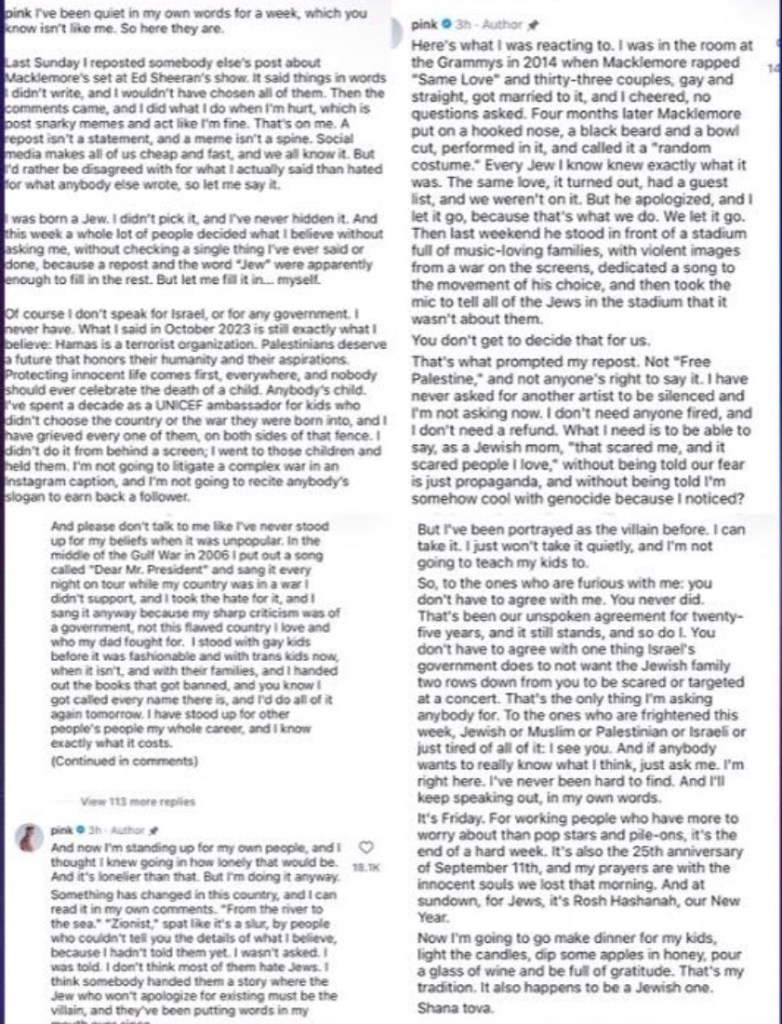
On Friday, Pink responded with a lengthy statement intended to clarify her position.
What followed was less a conventional celebrity statement than an attempt to reclaim control over a narrative that had already been defined by social media.
A controversy larger than one repost
Macklemore has increasingly used his platform to speak publicly about the war in Gaza and Palestinian rights. During recent performances at New Jersey’s MetLife Stadium, where he appeared as part of Ed Sheeran’s tour, the rapper performed Hind’s Hall and incorporated imagery connected to the conflict.
For Macklemore, political expression has become an established part of his public work. His 2024 song Hind’s Hall, named after Columbia University’s student occupation building, explicitly addressed the war in Gaza and criticism of US support for Israel.
Pink’s reaction was not presented as opposition to Palestinian advocacy itself.
In her statement, she specifically rejected the idea that she was asking for Macklemore to be silenced, removed from the tour or financially punished. Instead, she argued that Jewish audience members should be able to express fear or discomfort without being accused of supporting the actions of the Israeli government.
That distinction is central to understanding her response.
Pink separates Jewish identity from Israeli politics
Pink identifies herself as Jewish and says she has never hidden that fact. At the same time, she explicitly rejects the idea that Jewish identity automatically represents support for the Israeli government.
She says she does not speak for Israel or any government and reiterates positions she has previously expressed: that Hamas is a terrorist organisation and that Palestinians deserve a future that respects their humanity and aspirations.
Her statement therefore attempts to establish a position between categories that are increasingly treated as mutually exclusive online.
The political reality, however, is more complicated.
Criticism of the Israeli government is not inherently antisemitic, just as support for Palestinian rights is not inherently support for Hamas. At the same time, antisemitism can appear within political discourse about Israel and Palestine, particularly when criticism shifts from government policy to Jews as a collective group.
That distinction is one of the central tensions in Pink’s argument.
The Macklemore connection goes back more than a decade
Pink’s response also draws on an earlier chapter in Macklemore’s career.
She recalls the 2014 Grammy Awards, where Macklemore performed Same Love during a mass wedding ceremony involving 33 couples. The performance became one of the defining televised moments of the ceremony and reinforced Macklemore’s association with LGBTQ+ activism.
But that same period included controversy over a costume Macklemore wore that used antisemitic stereotypes. The rapper subsequently apologised.
For Pink, that history forms part of the context surrounding her recent reaction.
Her argument is not that Macklemore should never speak about Palestine. Rather, she questions whether he can determine how Jewish people should interpret imagery and political messaging connected to a conflict in which antisemitism is itself a significant concern.
Her formulation is essentially about perspective: Macklemore can explain his intention, but he cannot necessarily dictate how members of the audience experience it.
Celebrity activism has become part of the show
The dispute also raises a broader question about the relationship between entertainment and political activism.
Pop stars have long used concerts as political platforms. From anti-war performances to LGBTQ+ rights campaigns, musicians have routinely connected their work with political causes.
What has changed is the speed and scale with which those moments now circulate.
A statement made to thousands of people inside a stadium can reach millions online within minutes. A concert becomes a political news story; a political statement becomes a viral clip; and a celebrity’s response can become another news cycle in itself.
That dynamic makes the boundary between artistic expression and political advocacy increasingly difficult to define.
For audiences, however, the experience can be very different.
A concert is often marketed as entertainment, but the person on stage controls the environment, the imagery and the microphone. When political messages enter that space, audiences may experience them as either solidarity or confrontation depending on their own identity and political perspective.
That appears to be the tension Pink is describing.
Pink’s long history of political activism
Pink also used the statement to challenge the idea that she has suddenly become politically outspoken.
She pointed to Dear Mr. President, her 2006 song criticising President George W. Bush and the Iraq War, as well as her long-standing support for LGBTQ+ rights.
She also referenced her work with UNICEF and her advocacy for children affected by conflict.
This part of her response serves another purpose: establishing credibility.
Pink is effectively arguing that political disagreement has never been foreign to her career. She has previously accepted criticism for taking positions that were unpopular with sections of the public, and she does not intend to retreat from that approach now.
The difference, she suggests, is that this time the issue is connected directly to her own identity.
When political disagreement becomes personal
The most significant shift in Pink’s statement comes when she describes feeling increasingly isolated as she defends her Jewish identity.
She refers to comments using phrases such as “From the river to the sea” and accusations of being a “Zionist”. Her complaint is that these labels were applied before people had actually asked her what she believed.
This reflects a broader problem within online political discourse: identity has increasingly become a shortcut for interpretation.
Instead of asking what someone believes, audiences often infer their position from their religion, ethnicity, nationality, political vocabulary or associations.
For a celebrity, the process is amplified.
Millions of followers can construct a version of a public figure’s politics based on a single post, while the celebrity is expected to respond immediately and definitively.
Pink’s decision to write a detailed statement can therefore be read as an attempt to slow that process down.
The limits of the celebrity statement
There is also a degree of contradiction in Pink’s response.
She criticises social media for reducing complex political issues to simplistic statements, yet her own response remains part of the same social-media ecosystem. It is a public statement designed to clarify a controversy created by another public statement.
That does not make her argument invalid. But it demonstrates the difficulty of escaping the cycle.
Celebrity activism increasingly operates within an environment where every statement becomes content.
Silence can be interpreted as complicity. Speaking can produce backlash. Reposting can be treated as endorsement. Clarifying can create another controversy.
For artists, there may no longer be a neutral position.
Beyond Pink and Macklemore
The significance of this dispute ultimately extends beyond two musicians.
The argument illustrates how difficult it has become to discuss Israel and Palestine in public without collapsing political positions, national identities and religious identities into one another.
It also demonstrates the particular pressure placed on celebrities who speak about conflicts that have immediate consequences for different communities within their own audiences.
Macklemore’s position is that Palestinian suffering deserves public attention.
Pink’s position is that Jewish fear and vulnerability deserve space within that conversation as well.
Those arguments are not necessarily incompatible.
The more difficult task is creating a public conversation in which acknowledging one does not require erasing the other.
Pink ended her statement by moving away from the controversy entirely. She described preparing dinner for her children, lighting candles and celebrating Rosh Hashanah with her family.
It was an intentionally personal ending to a highly political statement.
And it underlined the central issue at the heart of the controversy: for Pink, Jewish identity is not simply a position on the Israeli government. It is also family, history, culture and tradition.
Whether her critics accept her explanation is another matter.
But the episode demonstrates something increasingly important in celebrity culture: a repost can start a political controversy, but it cannot necessarily explain a person’s politics.