
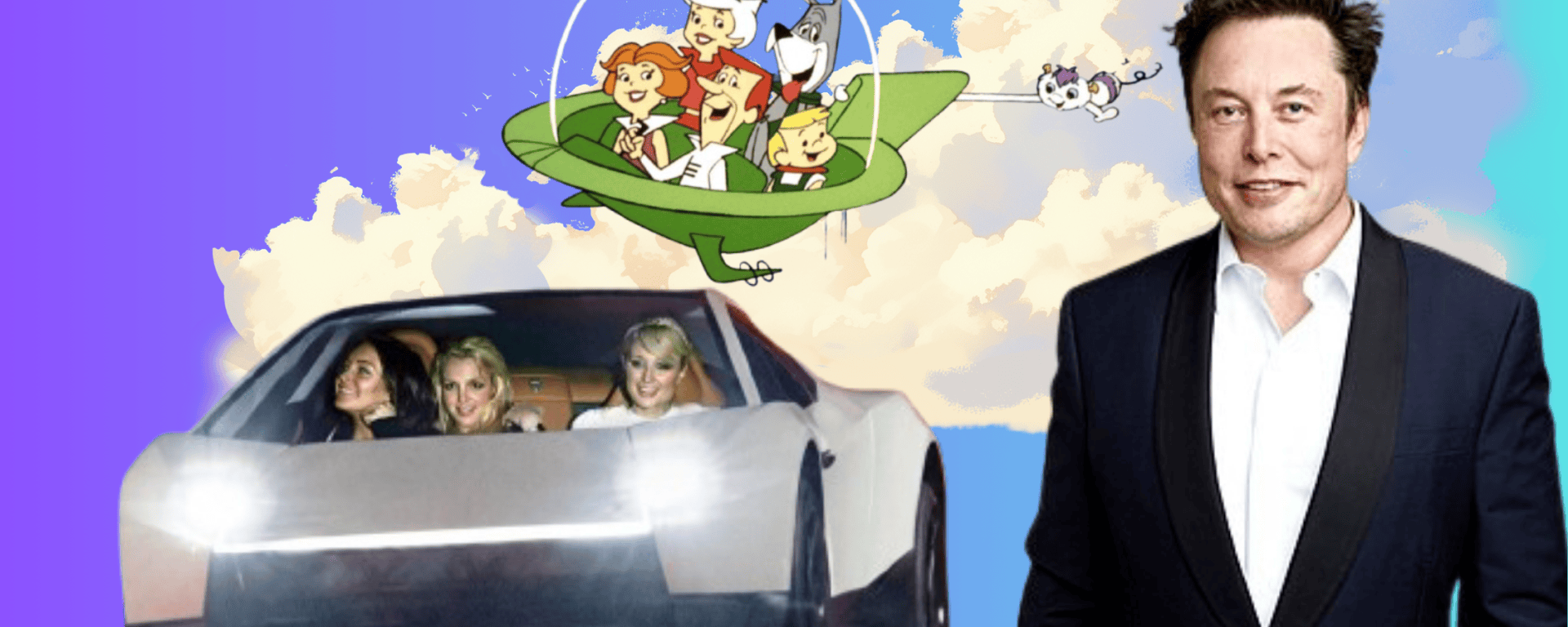

From The Jetsons to The Dukes of Hazzard, Elon Musk’s latest Tesla spectacle feels like every childhood science-fiction fantasy rolled into one. But do we actually want to live in the future billionaires imagined when they were twelve?
I don’t know about you guys, but this week has felt like someone opened a dusty VHS collection from the late 1970s and 1980s, threw in a little The Jetsons, a generous helping of The Dukes of Hazzard, and handed the whole thing to Elon Musk with an unlimited budget.
Because apparently, flying cars are now a thing.
And my immediate reaction was: REALLY?
Are we seriously entering an era in which the next generation might need to worry less about passing their driving test and more about obtaining a pilot’s licence?
Will teenagers be learning how to parallel park in the sky? Will driving instructors have to explain emergency landings? And, most importantly, will we eventually have to deal with airborne traffic jams?
I have questions. Quite a few, actually.
Houston, We Have a Flying Tesla
On October 15, Elon Musk unveiled Tesla’s long-awaited next-generation Roadster at a SpaceX facility in McGregor, Texas.
And this wasn’t exactly your average car launch.
The vehicle demonstrated extraordinary acceleration, drove upside down using a powerful suction system and launched itself into the air, performing an aerial stunt over other Tesla vehicles.
The technology combines Tesla’s electric engineering with SpaceX-inspired propulsion systems, using highly compressed air to generate thrust.
According to reports, Tesla claims the Roadster can accelerate from 0 to 60 mph in approximately 0.8 seconds.
Musk says production is expected to begin in 2028.
But before we start cancelling our driving lessons and enrolling in flight school, there is an important distinction.
The Roadster has demonstrated brief airborne manoeuvres, not the ability to operate as an everyday flying commuter vehicle.
Its extraordinary Rocket version is not approved for public roads, and questions remain about regulation, safety and how long it can actually stay airborne.
So, no, we aren’t quite ready to fly to Tesco.
Not yet, anyway.
The Jetsons Called. They Want Their Future Back.
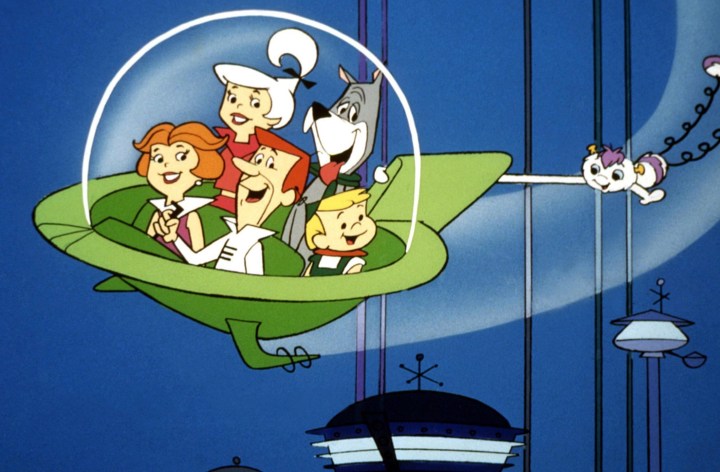
For decades, popular culture has promised us a future filled with flying vehicles, robotic assistants and cities suspended somewhere between the clouds and a spectacular architectural hallucination.
The Jetsons, which premiered in 1962, imagined a society where commuting through the sky was as ordinary as making breakfast
By the late 1970s and 1980s, science fiction had become increasingly obsessed with machines that could transform, fly, fight and occasionally save humanity before lunchtime.
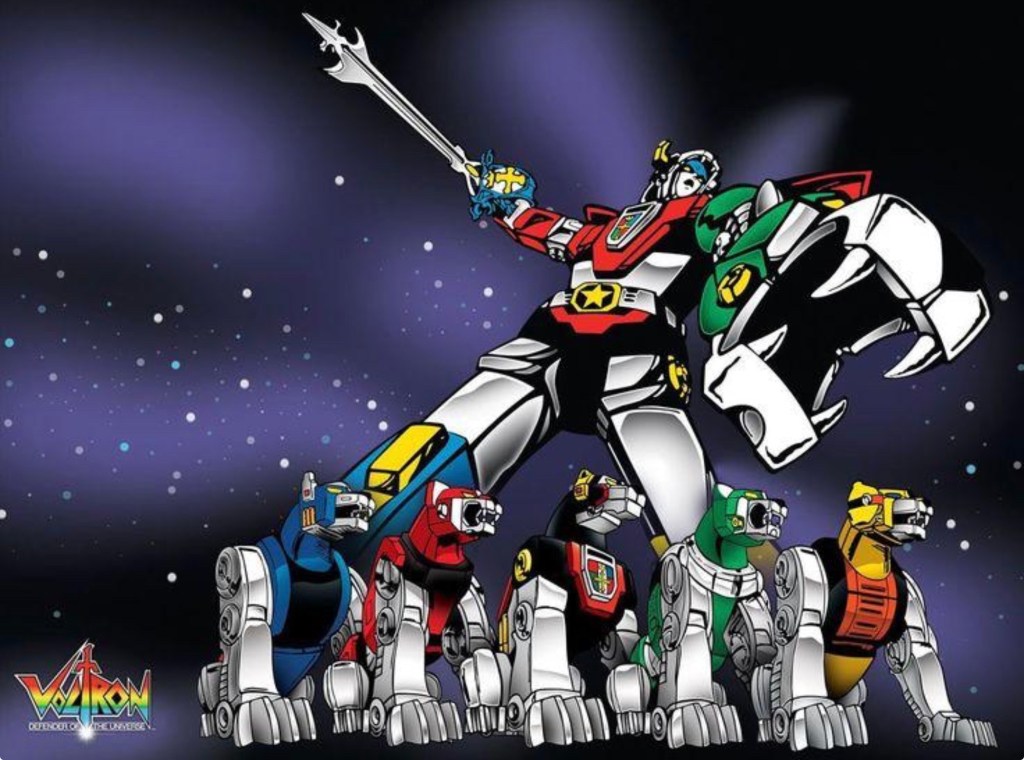
Think Voltron, Transformers, Knight Rider and eventually Power Rangers.
The recurring message was simple: the future would be mechanical, spectacular and preferably capable of shooting something.
Now look at the world Musk is building.
Electric cars. Humanoid robots. Rockets. Artificial intelligence. Autonomous vehicles. And now a sports car that apparently wants to audition for a superhero franchise.
You can almost imagine a young Elon sitting in front of the television, watching giant robots and futuristic vehicles, thinking: one day, I’m going to build all of this.
I’m not suggesting that Voltron secretly inspired Tesla’s engineering department. That would be an entertaining but entirely unsubstantiated theory.
However, the cultural parallels are fascinating.
Much of today’s technological ambition appears remarkably similar to the science-fiction fantasies that shaped previous generations.
The difference is that somebody finally has enough money to attempt to manufacture them.
Imagine Kim Kardashian Going Shopping in a Flying Car
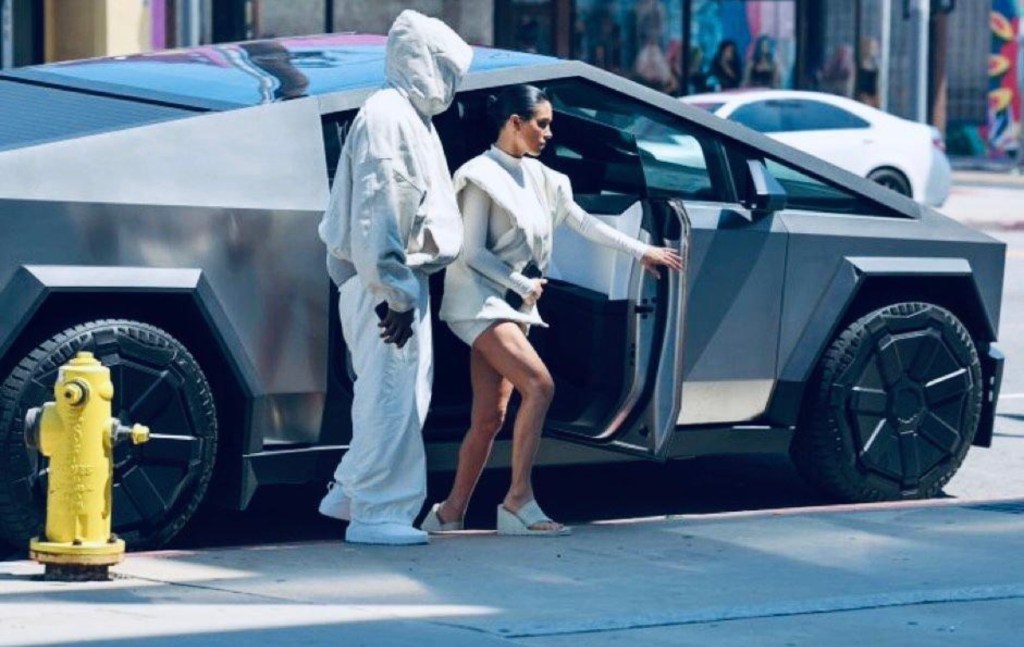
Now, allow me to imagine the inevitable celebrity implications.
Picture Beverly Hills in 2035.
Kim Kardashian has decided she needs another handbag.
Her driver is waiting outside, except the vehicle isn’t technically parked. It’s hovering above the driveway.
She gets in, puts on her sunglasses and casually requests a route to Rodeo Drive.
Five minutes later, she’s floating above Los Angeles, avoiding traffic while her futuristic navigation system announces that another flying vehicle is approaching from the direction of Kylie Jenner’s house.
Somewhere above Sunset Boulevard, two influencers are arguing over aerial parking privileges.
Meanwhile, a paparazzo is attempting to photograph the entire situation using a drone.
Welcome to the future. Same celebrity culture, different altitude.
It’s ridiculous, of course, but is it really that difficult to imagine?
The automobile has always been more than transportation. It represents status, freedom, wealth and identity.
A flying luxury vehicle would simply take that symbolism into another dimension.
Literally.
And if history has taught us anything, it’s that once a new form of luxury transportation becomes available, celebrity culture will find a way to turn it into content.
Is Elon Musk Building the Future or His Own Childhood?
Here’s where things become particularly interesting.
Musk’s technological universe increasingly resembles a science-fiction crossover in which every machine has been designed to perform a different childhood fantasy.
Tesla’s Optimus project explores humanoid robotics. SpaceX is pursuing interplanetary travel. Neuralink is developing brain-computer interfaces. And Tesla continues to invest in artificial intelligence and autonomous transportation.
Individually, these projects represent different technological ambitions.
Together, they create something that looks suspiciously like the opening credits of an extremely expensive 1980s cartoon.
At this rate, I half expect Musk to announce that he’s developing a giant robotic suit, transform into a Power Ranger and disappear into the universe searching for a civilisation of higher-level humans.
Perhaps he’ll encounter Voltron somewhere near Mars.
Perhaps the robot will tell him that humanity needs saving.
Perhaps somebody will finally explain why every technological breakthrough apparently needs to resemble a science-fiction movie.
The cultural question, however, is more serious than the joke.
When billionaires possess the resources to turn their personal visions of the future into reality, whose imagination gets to determine what progress looks like?
Science fiction has always influenced technological development. But fictional worlds are built around narrative possibilities, not necessarily the practical needs of everyday society.
A flying sports car is undeniably impressive.
Whether it represents the future humanity actually needs is another conversation
Do We Really Need Traffic Jams in the Sky?
There is also the rather inconvenient matter of reality.
Flying vehicles introduce challenges that ordinary cars do not face to the same degree: controlled airspace, emergency landings, noise, public safety, infrastructure and regulatory oversight.
Following Tesla’s unveiling, CBS News reported that even determining which authorities would oversee a vehicle combining road and flight capabilities was not straightforward.
And then there is accessibility.
If flying cars eventually become commercially viable, who will be able to afford them?
Will they revolutionise mobility for everyone, or simply provide wealthy consumers with another opportunity to rise above problems the rest of society must continue navigating?
Imagine a future where ordinary workers remain stuck in traffic while billionaires literally fly over their heads.
It’s an almost painfully accurate metaphor for economic inequality.
Technological progress is exciting, but innovation alone does not guarantee social progress.
We can build increasingly sophisticated machines while leaving basic human problems unresolved.
A vehicle capable of performing aerial acrobatics is remarkable engineering. It does not automatically make housing more affordable, cities more accessible or public transport more efficient.
And perhaps that distinction deserves as much attention as the spectacular launch itself.
Maybe We Don’t Need Another Superhero. Maybe We Just Need a Better Future.
There is something genuinely wonderful about watching an idea that once belonged exclusively to cartoons and science-fiction films begin to materialise.
The Roadster demonstration deserves recognition for pushing automotive engineering into unusual territory.
But it also illustrates our complicated relationship with technological progress.
We want the future to look extraordinary. We want machines that challenge expectations. We want the impossible to become possible.
Yet we rarely stop to ask whether the future we’re being sold is the one we actually imagined for ourselves.
Maybe Musk really is building the technological equivalent of his childhood science-fiction universe.
Maybe one day we’ll look up and see flying vehicles crossing the skyline like an episode of The Jetsons.
Maybe Kim Kardashian really will need an aerial parking permit.
But until then, I’d quite like a future where technology makes ordinary life easier, rather than one where we all have to train like Power Rangers just to get to the supermarket.
Because as entertaining as a real-life Voltron universe might be, I’m not entirely convinced humanity needs another billionaire preparing to save the galaxy.
Especially when we’re still trying to figure out how to save ourselves.
And please, Elon, before you give us flying cars, can somebody invent a robot that successfully folds fitted sheets?
Now THAT would be revolutionary.

