

There was a time when provocation required effort.
The great provocateurs of the twentieth century risked careers, prison, public outrage, sometimes even their safety. They challenged religion, politics, morality, war. They scandalized society because they were trying to expose something hidden beneath it.
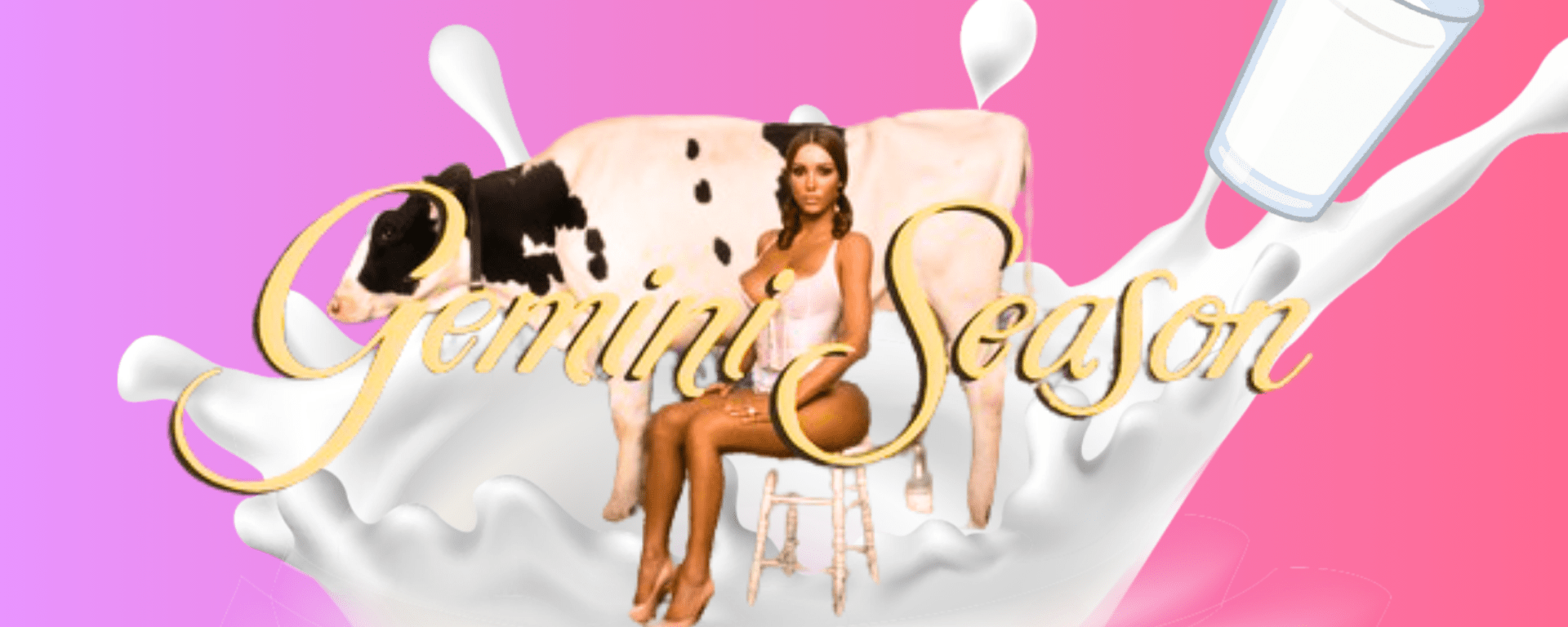
In 2026, meanwhile, one of the richest celebrities on Earth films his wife milking a cow in the Alps before pouring the milk over her chest, uploads it to the internet, and waits for culture to do what culture always does: mistake attention for significance.
That, in essence, is Gemini Season.
The ninety-second visual released as part of Ye’s ongoing Bully rollout has already generated the predictable cycle of outrage, admiration, think pieces and algorithmic panic. Some viewers see daring performance art. Others see soft-core fetish content disguised as avant-garde cinema. Most people seem trapped somewhere between confusion and reluctant fascination, which is probably exactly where the creators wanted them.
The funny thing is that the video isn’t particularly shocking. What is shocking is how desperately it wants to be.
Nothing in Gemini Season feels dangerous. Every frame is too controlled, too polished, too aware of itself. The mountains are immaculate. The lighting is immaculate. Bianca Censori is immaculate. Even the cow appears to have signed a professional representation agreement beforehand.
The entire thing has the atmosphere of a luxury wellness retreat designed by people who believe human emotions are an inefficiency that can eventually be optimized through better architecture.
Watching it feels less like witnessing transgression and more like attending a presentation called Reimagining Dairy Through Disruption.
This is where the video’s biggest contradiction emerges. Ye and Bianca clearly want the imagery to feel primal: milk, bodies, animals, nature, fertility. Yet everything about the execution feels aggressively artificial. The result is not eroticism, nor intimacy, nor even genuine weirdness. It is a kind of sterile sensuality that has become the defining visual language of both Silicon Valley and contemporary luxury culture.
The aesthetic says “return to nature” while costing more than most people’s annual salary.
The aesthetic says “raw authenticity” while requiring three creative directors, four stylists, a drone operator and probably a mood board containing the words liminal, organic and post-human.
This is why the video feels strangely familiar. Not because we’ve seen this exact imagery before, but because we’ve spent a decade being trained by the internet to recognize the formula.
Take something ordinary.
Remove all context.
Film it in slow motion.
Add expensive minimalism.
Refuse to explain anything.
Wait for critics to construct explanations on your behalf.
The modern art economy increasingly functions as a giant crowdsourced interpretation machine. The less meaning creators provide, the more meaning audiences generate. Every empty space becomes an invitation for projection.
A woman milking a cow becomes a meditation on consumption.
Milk becomes a metaphor for power.
A steel stool becomes a commentary on industrial modernity.
At some point, one begins to suspect that the audience is doing considerably more creative work than the artist.
And yet dismissing the video entirely would also miss the point. What Ye understands better than almost anyone is that attention itself has become the dominant artistic medium of the twenty-first century. The work is no longer the song. The work is no longer the video. The work is the conversation generated by the video.
In that sense, Gemini Season may be one of the most honest cultural artifacts of its moment.
The actual content is almost irrelevant. What matters is the argument. The discourse. The endless stream of reactions, reposts, debates and condemnations that follow. Every complaint becomes marketing. Every joke becomes distribution. Every article—including this one—becomes another brick in the promotional architecture.
The audience believes it is consuming the artwork when, in reality, the audience is part of the artwork.
Or perhaps part of the supply chain.
That is why the recurring discussion about whether Bianca Censori is empowered, exploited, brilliant, objectified, liberated, manipulated or strategically self-aware never really reaches a conclusion. The ambiguity is the product. The uncertainty keeps the machine running. If everyone agreed on what they were seeing, interest would collapse overnight.
The West-Censori partnership increasingly resembles less a marriage than a continuously operating content reactor. Every public appearance arrives pre-packaged as a cultural event. Every photograph doubles as a press release. Every controversy functions as audience acquisition.
It is reality television for people who think they are too sophisticated to watch reality television.
And perhaps that is the real achievement of Gemini Season. Not that it challenges social norms, but that it perfectly captures a cultural moment in which shock has become routine, transgression has become branding, and artistic rebellion has become indistinguishable from luxury marketing.
The video wants to feel like an attack on convention. Instead, it feels like convention’s final form.
Beautifully photographed, relentlessly discussed, meticulously engineered and instantly monetized.
A work of art designed from the ground up for an age in which being talked about matters infinitely more than having something to say.
The milk, in the end, is merely a prop.
The algorithm is the real star of the show.

