

Few expected Chanel to feel new again. For several seasons, the storied French house seemed caught in repetition — its codes beautiful but predictable, its shows polished yet lacking surprise. That changed this week at Paris Fashion Week, when Matthieu Blazy unveiled his debut collection as creative director, earning a rare standing ovation — Anna Wintour among those applauding.
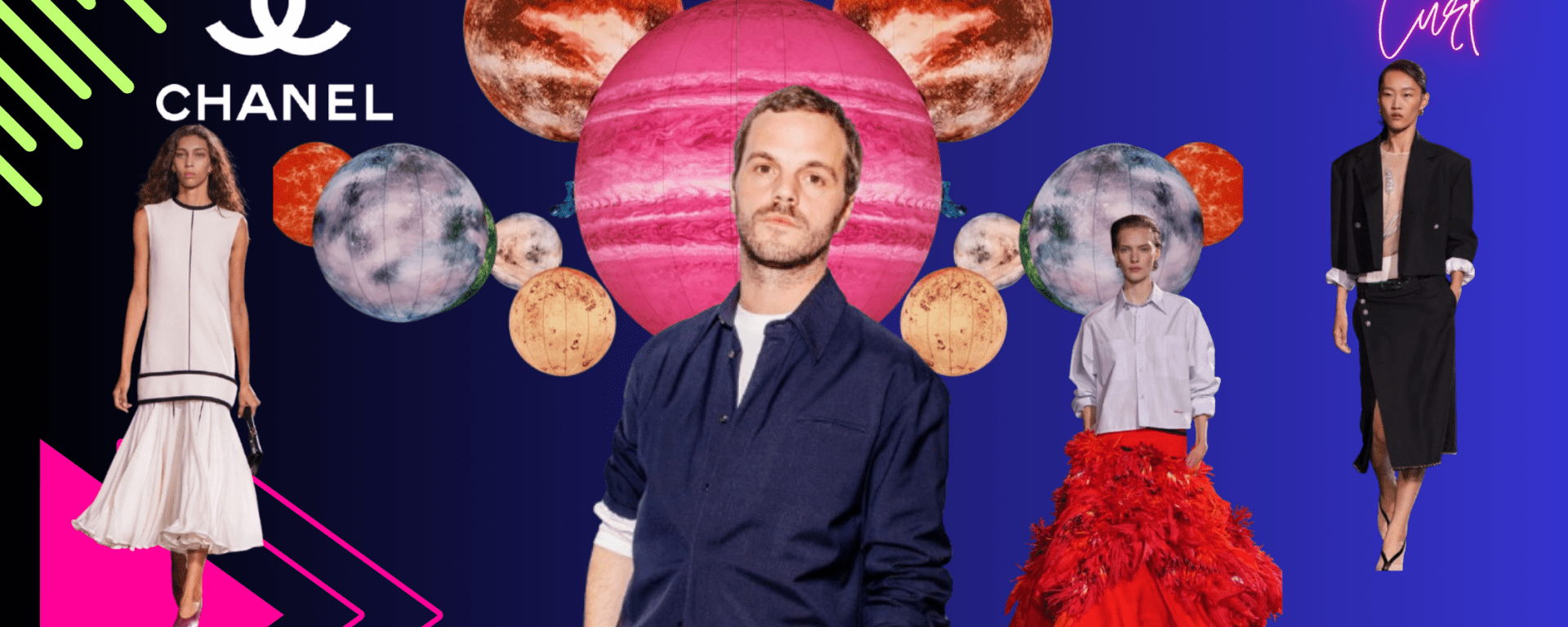
The show opened with a spectacle worthy of Chanel’s grandeur: a reflective runway mirroring a constellation of planets suspended above. The celestial theme, long dear to Coco Chanel, became Blazy’s poetic point of departure — a gesture that connected the house’s heritage to his own artistic sensibility.
From the first look, it was clear that this was not a nostalgic retelling but a recalibration. Blazy approached the collection with a disciplined sense of renewal, steering Chanel away from its pastel-drenched comfort zone. Spring/Summer 2026 introduced a richer, more assertive palette dominated by deep reds and burgundies — a deliberate shift toward maturity and confidence.
The tailoring reflected that same evolution. Matching twinsets and demure skirt suits gave way to oversized shirts, lightly structured and subtly branded, projecting ease rather than rigidity. Tweed — Chanel’s eternal signature — reappeared, but in airier, more modern interpretations: mesh-like weaves, semi-transparent finishes, and delicately distressed surfaces that suggested both fragility and freedom.
Accessories, too, mirrored this relaxed modernity. Handbags were shown unfastened and loosely held, as if captured mid-movement, their nonchalance intentional. Footwear took on a sleeker profile — elongated and minimal, replacing the familiar platforms and cap-toe ballerinas with something far more refined.
Visually, Blazy balanced simplicity with structure. Several monochromatic ensembles edged in black geometric lines evoked the works of Piet Mondrian, a reference that aligns with the designer’s known affinity for the intersection of art and fashion.
Yet, the strongest imprint came through texture and craftsmanship — the designer’s own language. Fringed detailing, layered materials, and sculptural silhouettes recalled his previous work at Bottega Veneta, yet here they felt more painterly than pragmatic. Three-dimensional fringes framed long, mermaid-like dresses, offering one of the collection’s most memorable moments — both romantic and architectural.
Blazy’s debut suggests a new rhythm for Chanel: one that honors the brand’s legacy while allowing space for artistic interpretation. It marks a thoughtful departure from the house’s formulaic past, positioning it once again at the forefront of conversation.
The reactions have been divided — as any true creative shift tends to provoke — but the consensus among industry insiders is clear: Chanel, at last, feels awake again.
 curlycurlworld: Get Twisted with CurlyCurl: The Latest in Curls, Coils, and Confidence!