
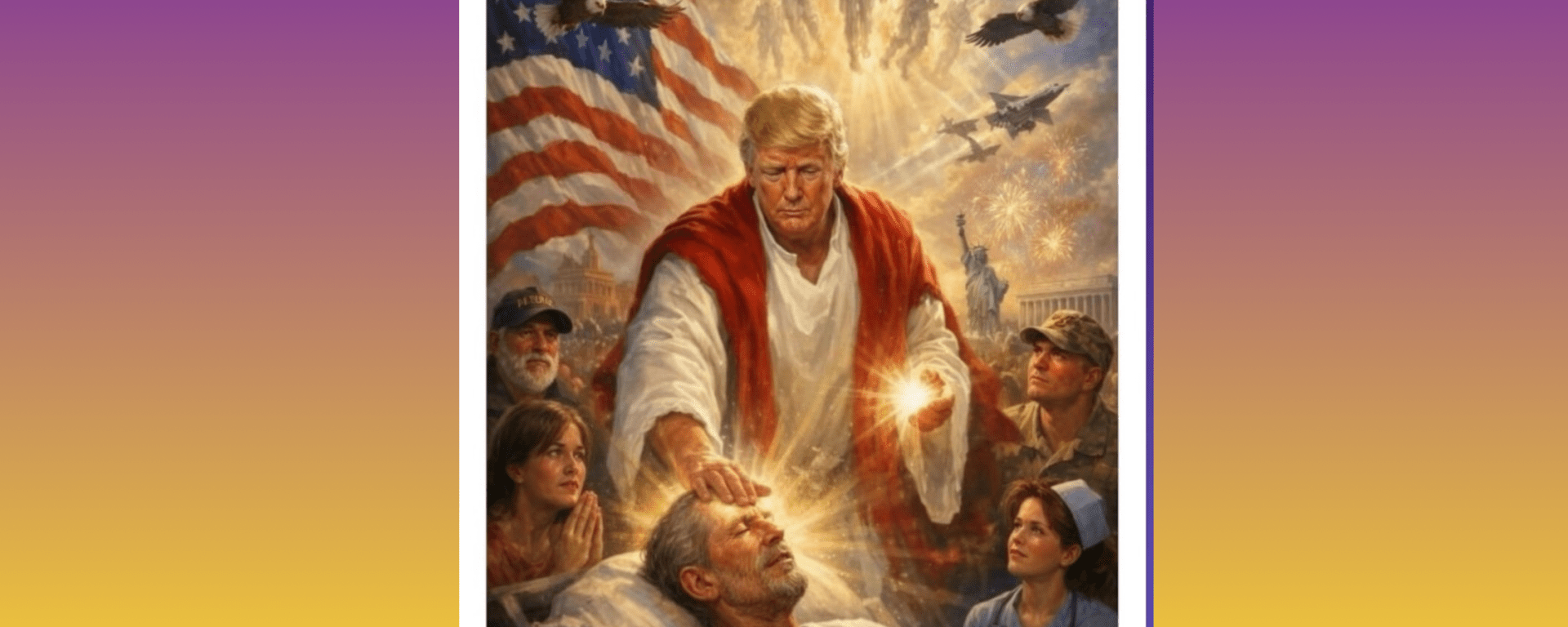

The internet may not have “broken,” but moments like this make it feel like we’re getting close.
Recently, Donald Trump shared an AI-generated image depicting himself in the likeness of Jesus Christ. The post quickly spread across platforms, triggering a wave of reactions—from strong among loyal supporters to sharp criticism from religious groups, political commentators, and everyday users.
Let’s be clear about the facts: the image is not real, but digitally created. There’s no official statement framing it as religious messaging or satire, which leaves interpretation entirely up to the public. This ambiguity is exactly what fuels virality—it invites debate, outrage, and endless engagement.
But beyond the immediate shock value, this moment highlights something deeper about where we are today.
We’re living in a digital ecosystem where the boundaries between symbolism, provocation, and identity are increasingly blurred. Public figures—especially ones as polarizing as Trump—often operate in a space where attention is the ultimate goal. And in that space, controversy isn’t a side effect; it’s a strategy.
Religious imagery, in particular, carries immense cultural and emotional weight. Historically, comparing political leaders to divine figures has been seen as controversial or even taboo. That’s why this image hits differently—it taps into something deeply personal for many people, regardless of political affiliation.
At the same time, it raises questions about how desensitized we’ve become. Just a few years ago, an image like this might have dominated headlines for weeks. Today, it’s one more flashpoint in an endless stream of viral content.
So have we reached the limit?
Maybe not. But we’re definitely testing it.
Because this isn’t just about one post. It’s about a culture that rewards extremes, algorithms that amplify outrage, and audiences that keep scrolling, reacting, and sharing—often without pausing to reflect.
And that’s the uncomfortable truth: moments like this don’t just happen because someone posts them. They explode because we make them explode.
So the real question isn’t just “Has it gone too far?”
It’s “Why does this keep working?”
 curlycurlworld: Get Twisted with CurlyCurl: The Latest in Curls, Coils, and Confidence!