
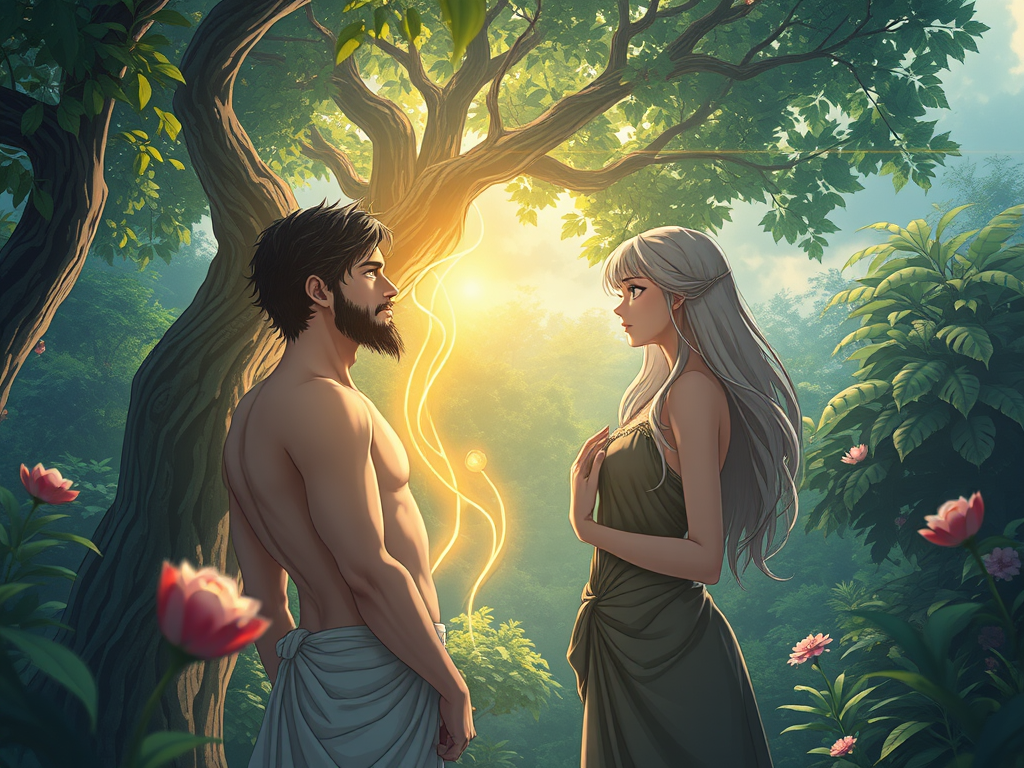

The story of Adam and Eve is often treated as a literal account of humanity’s beginning, yet its deeper power lies in its symbolism. When read beyond the surface, this biblical story reveals itself as a blueprint for the human condition—explaining why we experience separation, identity, time, and longing in the way that we do.
In the Garden of Eden, Adam and Eve exist in complete unity. There is no separation between humanity, God, or creation. Consciousness is whole and undivided. There is no ego, no personal identity, and no sense of “other.” Awareness simply is. In this state, existence is not experienced as “I am me,” but as “I am.” This reflects what many spiritual traditions describe as non-dual consciousness, where reality is perceived as one unified whole rather than a collection of separate parts.
Everything changes with the tree of the knowledge of good and evil. This knowledge is not merely about morality; it represents the birth of duality. Once Adam and Eve eat from the tree, reality becomes polarized. Good and evil emerge. Self and other appear. With this shift, ego is born, and identity takes form. Where identity exists, shame and fear soon follow, because the self now sees itself as separate and vulnerable.
The moment consciousness becomes “I am me,” separation becomes unavoidable. If I am me, then you are not me. Relationship replaces unity, and division becomes the primary way reality is experienced. Separation from one another naturally leads to separation from God, not because God withdraws, but because humanity now defines reality through personal identity rather than divine unity. This is the true meaning of exile from Eden—a shift in awareness rather than a physical departure.
This symbolic fall becomes even clearer when we consider the nature of time. God exists beyond space and time in a single eternal now. Modern physics reflects this idea through the block universe theory, which suggests that past, present, and future all exist simultaneously. Humans, however, experience time sequentially due to the limitations of physical existence. We move from moment to moment rather than inhabiting eternity.
This mirrors what the Bible calls the fall of humanity. Humanity falls from unified, eternal awareness into a three-dimensional experience where time is fragmented and identity is divided. The phrase “the fall” is not simply a theological judgment—it is a description of consciousness entering separation.
Once time and identity fragment, duality governs human life. Competition replaces cooperation. Comparison replaces compassion. Ego must constantly defend itself, and that defense often manifests as conflict, fear, and suffering. This is why war, division, and injustice are not anomalies but expressions of dualistic consciousness on a collective scale. The serpent in the Adam and Eve story symbolizes this pull toward ego and self-definition—the temptation to define ourselves apart from unity.
Yet the biblical narrative does not end in separation. Christianity offers a path back to unity through Jesus Christ. Jesus consistently teaches a way of being that dissolves duality rather than reinforcing it. Loving enemies, releasing judgment, and recognizing that the kingdom of heaven is within are not merely moral teachings; they are instructions for transcending ego-based awareness.
Jesus embodies non-dual consciousness while fully participating in human life. His resurrection symbolizes that unity with God is not lost, only forgotten. It reveals that separation is not the final truth of existence. His life points to a way of perceiving reality that restores union even while living within time and space.
The story of Adam and Eve, then, is not about failure. It is about awakening. It explains why humans experience division and longing, and it quietly asks how unity can be remembered within a divided world. Perhaps redemption is not about escaping humanity, but about transforming perception.
The fall was a fall into duality. Redemption is the remembering of oneness. And that remembering begins, as it always has, within us.
 curlycurlworld: Get Twisted with CurlyCurl: The Latest in Curls, Coils, and Confidence!