
🧠
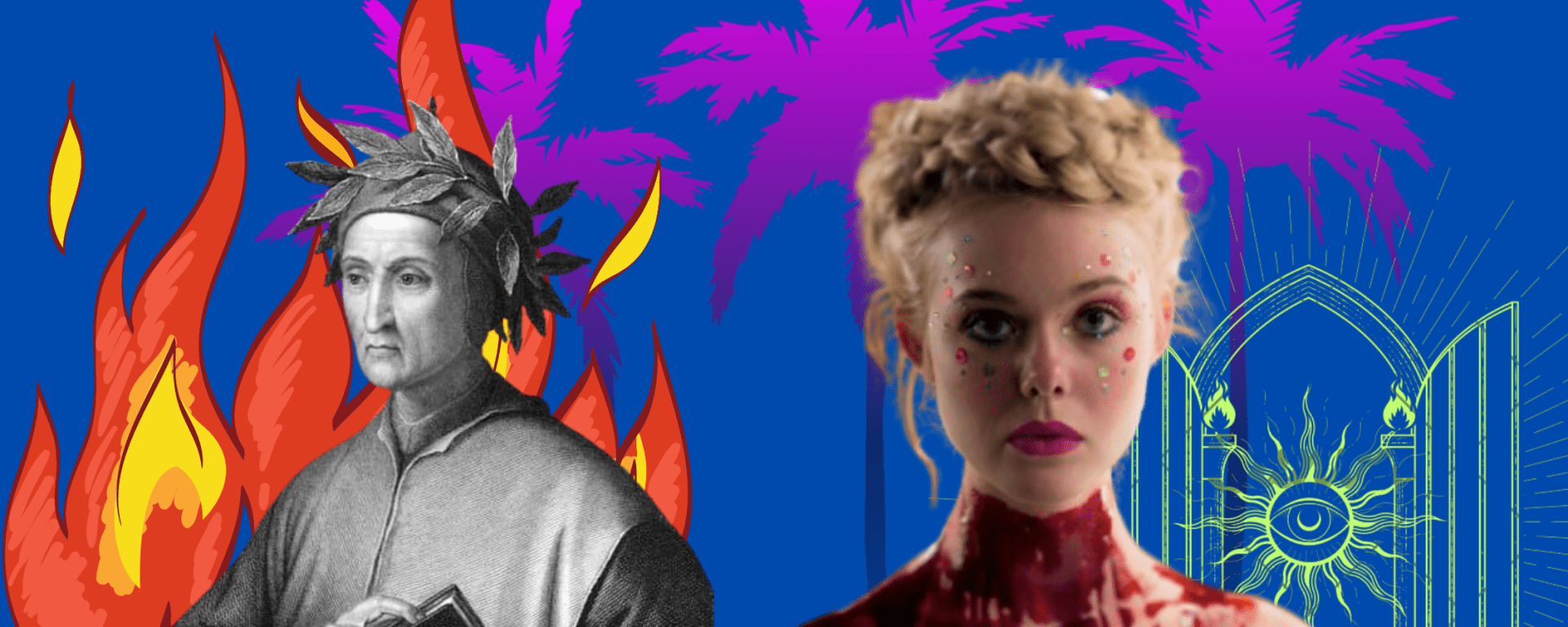
Nicolas Winding Refn’s The Neon Demon hides a shocking connection to Dante’s Inferno. From the three beasts to the descent through vanity and sin, this investigative analysis explores how modern beauty culture mirrors Hell itself.
🔥 What Connects Dante to This Horror Movie? The Hidden Inferno of
The Neon Demon
Imagine arriving in Los Angeles with nothing but ambition, youth, and beauty. You’re a novice model, broke but hopeful, chasing a dream that glows brighter than the city lights.
Soon, agents and photographers begin to notice you. You start to outshine the others — even the established supermodels who’ve spent years fighting for visibility.
But in the shimmering world of fashion, light always casts shadows.
And beauty, like sin, demands its sacrifice.
This is the world of The Neon Demon (2016), Nicolas Winding Refn’s visually hypnotic horror film that transforms the glamour of Los Angeles into something biblical — a modern Inferno, written in neon and blood.
Beneath its stylized surfaces lies a hidden structure inspired by Dante Alighieri’s Divine Comedy.
What begins as a coming-of-age story becomes a descent into a hell built on vanity, lust, and greed — the same sins Dante chronicled seven centuries ago.
🌆
Los Angeles: A Modern Dark Forest
Dante opens his Inferno with the line:
“In the middle of the journey of our life, I found myself in a dark wood, for the straight way had been lost.”
In The Neon Demon, Los Angeles is that dark wood — a dazzling labyrinth where the “straight way” of innocence is devoured by the serpents of desire and ambition.
Refn’s L.A. is a mirror-world where beauty becomes currency, and the soul’s worth is measured by symmetry and skin tone.
It’s not a city of angels but of fallen ones — each chasing a reflection that can never love them back.
When Jesse (Elle Fanning) arrives, she embodies purity — untouched, radiant, almost sacred.
She is the modern Beatrice and Dante combined: both the pilgrim and the vision of unattainable perfection.
Yet the same light that makes her divine also marks her for destruction.
🧩
The Symbolism of the Three Beasts
Dante’s path through the forest is blocked by three beasts:
- A leopard, symbol of lust and deception
- A lion, symbol of pride and power
- A she-wolf, symbol of greed and insatiable hunger
In Refn’s reinterpretation, these beasts appear as three women who embody the psychological monsters of the fashion world:
🦁
Gigi – The Lion (Pride Made Flesh)
Gigi, her face sculpted by endless plastic surgery, wears her pride like armor.
She represents the illusion of control — the belief that perfection can be engineered. Her pride hides fear: fear of aging, irrelevance, and invisibility.
Like Dante’s lion, she’s bold and golden on the surface but hollow inside — roaring to drown out her own despair.
🐆
Ruby – The Leopard (Lust and Corruption)
Ruby, the makeup artist, is the film’s most complex predator.
Her initial tenderness toward Jesse soon reveals a darker obsession.
Her sexuality, first sensual, becomes grotesque. When her advances are rejected, she turns to necrophilia — love without life, desire stripped of humanity.
In Dante’s moral universe, lust consumes reason. In The Neon Demon, Ruby’s lust consumes identity.
Her need to possess beauty leads her to defile it.
🐺
Sarah – The She-Wolf (Greed and Envy)
Sarah is the embodiment of hunger. She devours beauty with her eyes, her envy so intense it becomes physical.
When she looks at Jesse, she doesn’t just see competition — she sees what she can never be again: innocence.
Like Dante’s she-wolf, Sarah’s greed is endless. She wants not only to be beautiful but to consume beauty itself.
Together, Gigi, Ruby, and Sarah form a triple manifestation of sin — a living Cerberus guarding the gates of vanity’s hell.
💎
Jesse: The Diamond and the Divine
Jesse enters this world as a blank canvas — a young woman with no history, no corruption, only raw radiance.
Her rise mirrors the soul’s journey through temptation. At first, she is humble, even fragile. But the industry feeds her ego like a drug.
She begins to see herself as superior — chosen, almost supernatural.
“I don’t want to be them,” Jesse says in one scene. “They want to be me.”
That single line marks her transformation. She has crossed from purity to pride — the first step in every fall from grace.
In Dante’s cosmology, salvation lies in humility and self-knowledge.
In Refn’s Hollywood, those virtues are impossible.
Jesse becomes a living idol, worshipped by those who soon tear her apart, literally and metaphorically.
Her death — violent, ritualistic, and strangely aesthetic — becomes the film’s ultimate irony:
she achieves immortality not through fame, but through annihilation.
Like Dante’s damned souls, she becomes what she worshipped — an image without life.
🎥
Cinematic Inferno: The Visual Language of Damnation
Refn’s direction transforms every frame into an allegory.
Light and shadow play the role of Heaven and Hell. Mirrors are portals to self-destruction. Every triangle of neon recalls the Holy Trinity — corrupted into a cult of self-worship.
The color palette tells its own story:
- Blue for innocence and purity
- Pink for seduction and transformation
- Red for sin, blood, and rebirth
Refn doesn’t just depict horror; he aestheticizes it.
Each shot feels like a painting from a new kind of Renaissance — one where angels are models and demons wear lipstick.
This is what makes The Neon Demon so haunting: its horror isn’t in gore or monsters, but in the reflection of our own obsessions.
It’s a mirror we’re afraid to look into because it shows the modern soul — addicted to its own image.
🪞
Vanity as the New Theology
Dante’s world was ruled by faith; ours is ruled by visibility.
In The Neon Demon, beauty replaces God — a new religion with its own commandments:
Be flawless. Be desired. Be immortal — even if it kills you.
Jesse’s journey exposes how this cult of image has turned self-worship into moral decay.
Social media, fame, and body perfection echo Dante’s circles of sin, where the damned are trapped in endless reflections of their own vanity.
What Dante saw in Hell — the endless repetition of desire and punishment — is what Refn sees on Instagram: infinite mirrors, infinite hunger, infinite comparison.
🌌
Conclusion: The Divine Comedy in Neon and Flesh
The Neon Demon isn’t just a horror film — it’s a philosophical descent into the psychology of beauty.
Refn fuses Dante’s moral universe with our postmodern obsession with image, proving that Hell was never a place — it was always a reflection.
Dante climbed from darkness toward divine light.
Jesse falls from light into darkness, consumed by the same sins Dante warned us about centuries ago: pride, lust, and greed.
Both journeys end the same way — with revelation.
But while Dante found paradise, Jesse finds only the cold shimmer of neon — a false heaven that blinds instead of saves.
In the end, Refn’s message is terrifyingly simple:
Hell still exists. It just learned how to look beautiful.
 curlycurlworld: Get Twisted with CurlyCurl: The Latest in Curls, Coils, and Confidence!