
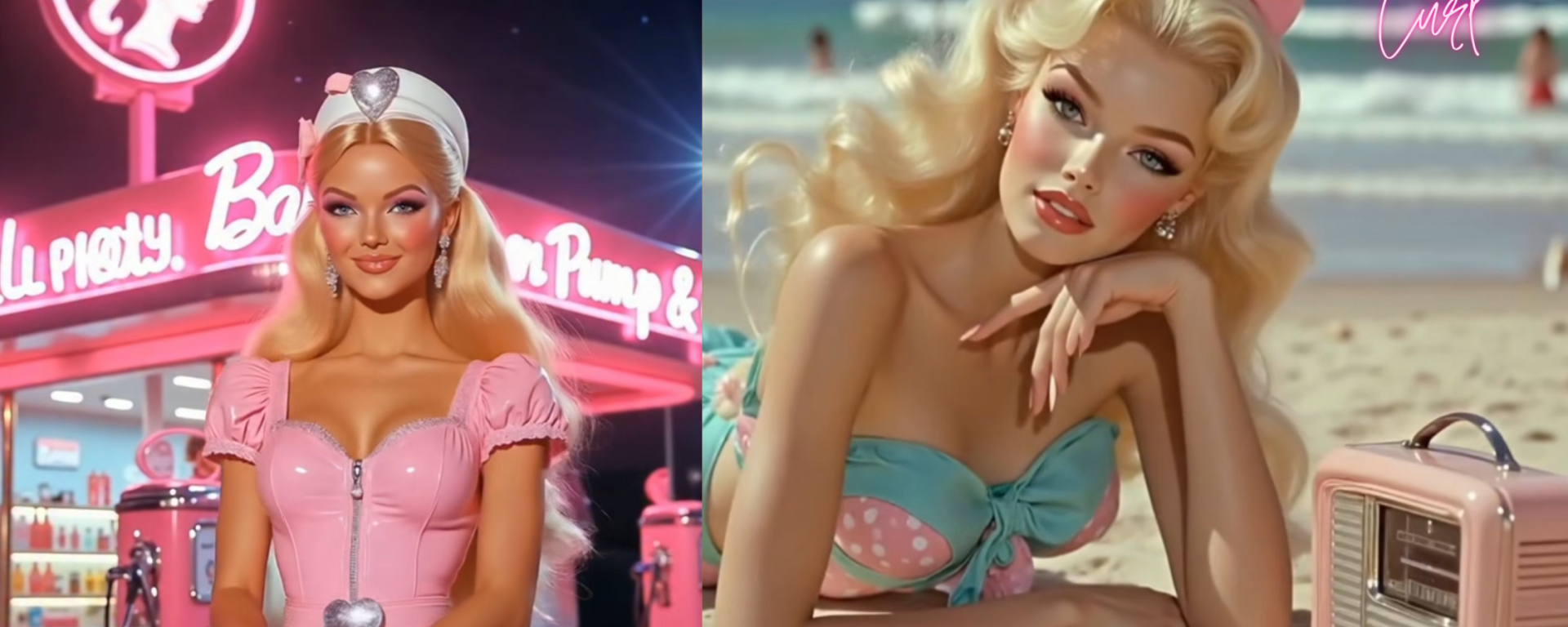

A few days ago, I found myself rewatching Barbie. I wasn’t expecting anything profound this time around; the novelty had worn off, and I thought I knew what to expect. But then the monologue arrived — Gloria’s speech, delivered by America Ferrera, the one that sparked standing ovations in theaters last summer. “It is literally impossible to be a woman… You have to be extraordinary, but somehow you’re always doing it wrong.” I had heard it before. I knew the words. Yet there I was, sitting in my living room, frozen, listening as if for the first time.
It’s rare that a blockbuster pauses for honesty. Most films built for mass appeal don’t risk saying something that could unsettle. But Gloria’s monologue unsettled precisely because it said the quiet part out loud. Women are told to be thin, but not too thin; ambitious, but never threatening; grateful, but still aware the game is rigged. These aren’t exaggerations for dramatic effect. They are the contradictions that structure ordinary life. And hearing them articulated — not in a feminist theory seminar, not in an activist manifesto, but in a pastel-colored Hollywood spectacle — was almost shocking.
The contradictions Gloria names have long been documented. Feminist philosophers from Simone de Beauvoir to Judith Butler have traced how femininity is both expected and punished, performed and policed. Sociologists call it the “double bind,” where the very qualities that allow a woman to succeed also trigger her undoing. The nonprofit Catalyst describes how female leaders who project authority are labeled as “unlikable,” while those who show warmth are seen as “ineffective.” Political scientists Michelle Ryan and Alexander Haslam coined the “glass cliff,” noting how women are often promoted during crises, given power only when it is least likely to last. These are not abstract concepts; they are realities hiding in performance reviews, campaign coverage, and everyday conversations.
What struck me on rewatch is how Barbie carries this critique through a doll once accused of embodying the very opposite. For decades, Barbie was shorthand for impossible beauty standards — the blonde, leggy figure whose proportions would be fatal if real. To hear a speech about the impossibility of womanhood inside a film about Barbie is an act of cultural judo. It takes the symbol of perfection and uses her to stage imperfection, fatigue, and disillusionment.
Some critics dismissed the monologue as simplistic, “Feminism 101” for audiences too untrained for nuance. But perhaps simplicity is the point. Women cried in theaters not because they learned something new, but because someone finally said it where everyone could hear. America Ferrera herself defended the scene: “We can know things and still need to hear them out loud.” There is relief in recognition, in having language for what is usually borne in silence.
Rewatching, I also realized how rare it is to see exhaustion taken seriously on screen. Gloria does not call for revolution; she confesses to weariness. That weariness is familiar: the friend who worries about being too assertive in meetings, the colleague who tries to “lean in” and is punished for arrogance, the mother who feels guilty for working too much and guilty for working too little. These are not failures of individuals, but symptoms of a system designed to keep women busy balancing contradictions rather than breaking them.
And the system persists. According to the World Economic Forum, it will take more than a century to close the global gender gap at the current pace. Women remain underrepresented in leadership, paid less than men for similar work, and disproportionately judged for their appearance, their tone, their choices. Gloria’s words do not fix any of this. But they strip away the alibi of ignorance. After Barbie, we cannot pretend the contradictions are invisible.
That, I think, is the film’s real achievement. It doesn’t end with utopia or even victory. It ends with acknowledgment — with the naming of something women already know, but rarely hear echoed back in spaces this large. And in that naming, there is a kind of solidarity. Watching again, I didn’t cry because I was surprised. I cried because I was seen.
Maybe that’s the quiet rebellion of Barbie. Not to solve the impossible, but to remind us that the impossibility is not ours alone to bear.
 curlycurlworld: Get Twisted with CurlyCurl: The Latest in Curls, Coils, and Confidence!