
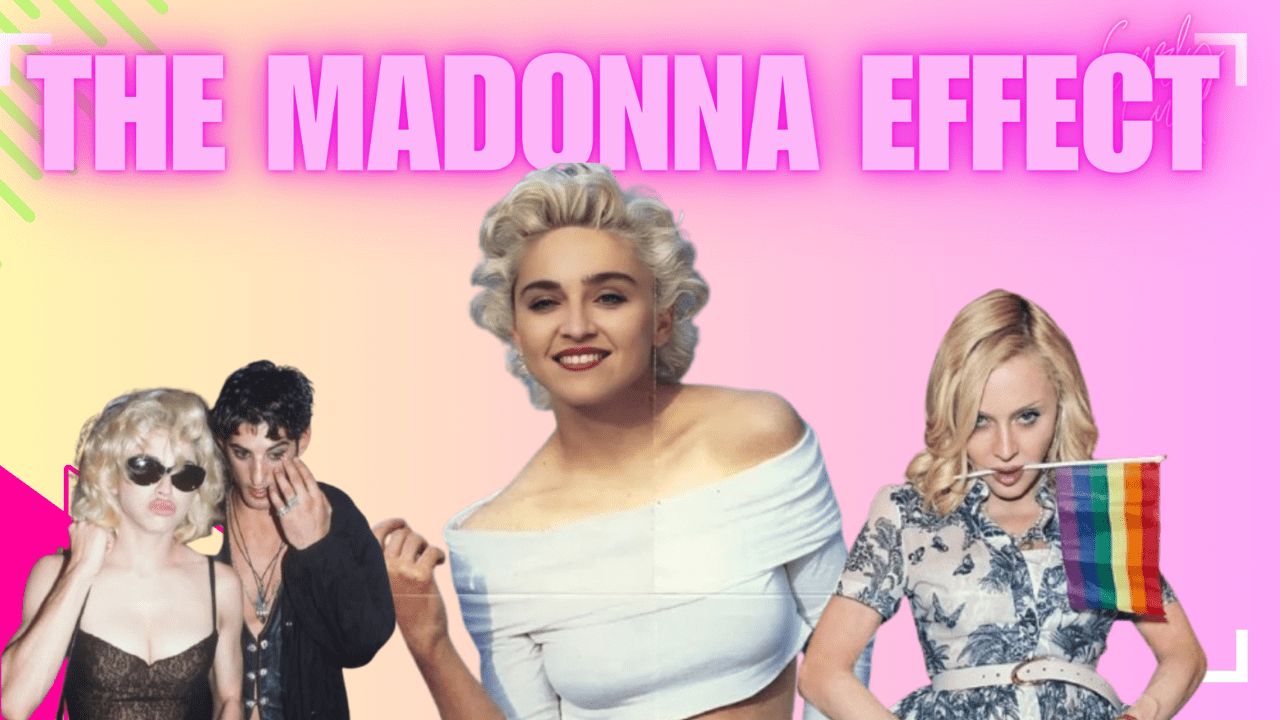

When Madonna appeared in the early 1980s, the music industry thought they had her figured out. A young woman with dance training, catchy hooks, and a rebellious streak. Another disposable pop act who would burn bright and fade quickly. But what actually happened was the opposite. Madonna didn’t just survive — she redefined what pop music could mean, and in the process, forced culture to confront questions it had been avoiding.
To understand Madonna, you have to understand her context. The 1980s in America were defined by conservative politics, Reagan-era family values, and the growing silence around the AIDS epidemic. Mainstream entertainment reflected that atmosphere. Pop stars were expected to be glamorous but safe, sexual but never explicit, fun but never political. Madonna’s career became the disruption of that template.
Her arrival coincided with MTV, a new platform that gave visuals the same power as sound. And Madonna understood instinctively that the music video was more than just marketing — it was a stage for performance art. In “Like a Virgin,” her performance at the very first MTV Video Music Awards, she rolled on the floor in a wedding dress, combining innocence and eroticism in a way that was shocking at the time. To a conservative public, this was indecency. To her fans, it was liberation. What’s interesting here is not simply that Madonna provoked outrage, but that she revealed how fragile the boundaries of American morality really were.
But her influence wasn’t just about sex or provocation. From the beginning, Madonna’s orbit included dancers, artists, and collaborators who were gay men, drag performers, and members of New York’s underground queer culture. By putting them in her videos, on her tours, and in front of MTV’s cameras, she was making a political statement through visibility. For many queer youth watching at home, this was the first time they saw fragments of their world reflected in mainstream media.
This visibility became even more significant in the shadow of AIDS. As the crisis deepened, silence dominated public conversation. Politicians refused to address it, media coverage stigmatized victims, and fear created isolation. Madonna, unlike most celebrities at the time, did not turn away. She spoke openly about safe sex. She included information about AIDS in her tour booklets. She dedicated performances to friends who had died. When others were cautious, Madonna risked being labeled inappropriate or obscene in order to speak about survival.
It’s tempting to dismiss these actions as publicity stunts, but that oversimplifies the reality. Every scandal Madonna endured — from religious backlash over “Like a Prayer,” to conservative outrage at her sexual imagery — functioned as a proxy war. She became the figure that society used to debate deeper anxieties: about female sexuality, about homosexuality, about religion, and about control. Her body, her art, her voice became symbolic territory. And she knew it.
Madonna’s genius wasn’t only in provocation, but in using controversy as fuel. When the Vatican condemned “Like a Prayer,” the video didn’t disappear — it became iconic. When Pepsi dropped her sponsorship, she didn’t fade — she became untouchable. The cycle repeated: outrage, debate, attention, and then influence. In this sense, her career wasn’t simply entertainment, it was pedagogy — a series of cultural lessons about where the fault lines in society were drawn.
And this is why Madonna’s role in the 1980s is so significant. She wasn’t the first pop star to be sexual, or political, or rebellious. But she was the first to merge all of those things with mass global visibility, in an era where visibility itself was radical. For the LGBTQ+ community, for women, for anyone told to stay quiet, she represented something larger than celebrity. She represented the possibility of being seen and heard in a world that wanted silence.
So if we study Madonna’s early career, we don’t just see a musician. We see a cultural agent — someone who exposed the fractures in 1980s society, and then exploited them, not only for her own fame, but for the visibility of people and issues the mainstream was ignoring. And whether you found her inspiring or offensive, one thing was certain: you couldn’t ignore her.
By the 1990s, Madonna was no longer a rising star. She was an institution. But institutions are easy to attack, and the bigger she became, the more she was targeted. What makes this phase of her career worth studying is not just the controversies she sparked, but the way she used reinvention as a strategy for survival — and in doing so, redefined the rules of pop culture.
In 1990, Madonna released “Vogue.” On the surface, it was a glamorous dance track, but its cultural significance went much deeper. “Vogue” was born from New York’s ballroom scene, a queer subculture led largely by Black and Latino LGBTQ+ communities. Vogueing — the dance form — was a celebration of style, resilience, and identity in a society that marginalized them. By bringing it to MTV, Madonna turned a subcultural art form into a global phenomenon. Critics debated whether she was appropriating or celebrating, but one thing was certain: she made the invisible visible. For queer youth outside of New York, “Vogue” was often the first time they saw this culture acknowledged on such a scale.
This visibility mattered. The early 1990s were still defined by the AIDS epidemic, which continued to devastate the LGBTQ+ community. In this climate, Madonna’s embrace of ballroom culture was not neutral — it was political. She positioned queer aesthetics not as taboo, but as aspirational. And while some accused her of exploitation, others saw it as an act of allyship that gave dignity and visibility to a community under siege.
But Madonna’s relationship with controversy didn’t stop at “Vogue.” In 1992, she released her album Erotica alongside a coffee-table book simply titled Sex. Both works pushed explicit imagery and unapologetic discussions of sexuality into mainstream culture. The backlash was immediate and ferocious. Politicians condemned her. Critics declared her career over. The media portrayed her as a symbol of moral decay.
Here’s the important point: Madonna wasn’t merely being provocative for its own sake. At the height of a global panic about sex and disease, she refused to participate in silence. The Sex book was outrageous, but it was also a challenge — a declaration that female desire was not shameful, and that conversations about sexuality could not be erased by stigma. While the world punished her for it, Madonna was articulating a vision of sexual freedom that directly confronted both patriarchy and homophobia.
What’s fascinating about this era is how Madonna absorbed the backlash and then shifted direction without surrendering her artistic identity. By the late 1990s, she released Ray of Light — an album infused with electronic sounds, spirituality, and maturity. Critics, many of whom had written her off during the Erotica era, suddenly praised her as an artist of depth and vision. This transformation was not accidental. It demonstrated how Madonna could navigate extremes — from scandal to respectability, from provocation to introspection — without ever losing control of her narrative.
This capacity for reinvention raises an important question: was Madonna simply a master of marketing, or was reinvention itself a political act? In a culture that demanded women stay consistent, predictable, and pleasing, Madonna’s constant transformation disrupted the expectation of stability. Reinvention became a refusal to be pinned down, a way of saying that identity itself can be fluid, shifting, and self-authored. In this sense, her artistry mirrored the struggles of marginalized groups whose identities were also policed by mainstream society.
The 1990s and early 2000s also highlight Madonna’s role as a mirror for cultural anxieties. When she embraced queer culture, critics asked if she was corrupting youth. When she released Sex, they asked if she was destroying morality. When she became a mother, they demanded she retire, as though motherhood disqualified her from being a pop star. Each stage of her career exposed society’s double standards — about sexuality, about gender, about age.
For female artists, especially, Madonna’s resilience was revolutionary. The music industry has long treated women as disposable, valuable only in youth, and replaceable once they age. Madonna refused this timeline. At 35, she was told she was too old for pop. At 45, she was mocked for dancing in a leotard. Yet she kept touring, recording, and breaking records. She challenged the notion that women must gracefully fade away while men like Mick Jagger or Paul McCartney are celebrated for performing well into their sixties and seventies. In doing so, Madonna made aging itself a political statement.
Her influence on younger artists became unmistakable. Britney Spears, Christina Aguilera, and later Lady Gaga and Beyoncé all drew from Madonna’s playbook: provocation, reinvention, spectacle, and activism. But the difference was that Madonna had absorbed the blows first. She endured the bans, the boycotts, the moral panics, so that later generations could operate with more freedom.
By the time the new millennium arrived, Madonna had endured nearly two decades of cultural combat. And what is remarkable is that she not only survived, but remained central to the conversation. Her tours broke records. Her albums continued to chart. And most importantly, she continued to provoke dialogue — whether about sex, religion, politics, or gender.
If we study this period of her career, we see more than scandals and reinventions. We see a model of cultural survival. Madonna demonstrated that in a society eager to control women and silence queer voices, reinvention could be both strategy and resistance. She showed that controversy, far from ending a career, could be transformed into fuel for longevity.
And perhaps this is why Madonna’s 1990s and early 2000s matter so much. They remind us that survival in hostile environments often requires transformation, adaptability, and audacity. Madonna was never just selling records — she was staging experiments in visibility, testing how much freedom an artist, a woman, and an ally could carve out in the spotlight.
By the time she entered the new century, Madonna had proven that she was more than a star of her generation. She was a case study in how culture changes — and how artists can force it to change.
And that leads us to the final question of her legacy: what does Madonna mean today, and what does she leave behind for the generations after her?
By the 2010s, Madonna had already lived several artistic lifetimes. She was no longer just a pop star; she was a permanent fixture of cultural history. But what happens when a figure who built their career on disruption becomes part of the establishment? What happens when the provocateur ages, while the world she helped shape keeps evolving? These are the questions that define Madonna’s legacy — and they reveal why her story is not finished, but still unfolding.
One of the first things we must acknowledge about Madonna’s later career is the presence of ageism. Throughout history, popular music has rewarded youth and punished aging, especially for women. Male rock stars are celebrated as legends when they grow old; female pop stars are often ridiculed or erased. Madonna refused to accept that erasure. She continued touring, releasing albums, and performing with the same intensity well into her fifties and sixties. The backlash was swift and cruel. Critics mocked her outfits. Headlines asked why she wouldn’t “act her age.” Social media turned her body into a punchline.
And yet, this resistance to aging gracefully — at least as society defines it — is precisely what makes Madonna’s later work so important. By refusing to step aside, she exposed how deeply our culture polices not just women’s sexuality, but women’s visibility. She forced us to confront the uncomfortable truth that we accept male longevity in music but punish women who refuse to disappear. In this sense, Madonna’s persistence itself is a political act, one that continues her lifelong project of challenging double standards.
But legacy isn’t just about survival — it’s about influence. And Madonna’s fingerprints are everywhere in contemporary pop. Lady Gaga’s performance art, Beyoncé’s political use of spectacle, Miley Cyrus’s sexual provocations, Rihanna’s reinventions — all of them borrow from Madonna’s blueprint. When Gaga arrived on the scene with “Born This Way,” many noted the resemblance to Madonna’s “Express Yourself.” Instead of denying it, Gaga embraced it, acknowledging Madonna as a forerunner. This is the paradox of legacy: when you influence the culture so profoundly, your work becomes both inescapable and, at times, invisible, because it’s embedded in the DNA of those who come after.
Beyond music, Madonna’s impact is visible in the LGBTQ+ movement itself. She was never the sole voice, but she was among the first megastars to amplify queer culture, speak out during the AIDS crisis, and normalize same-sex desire in her art. Today, LGBTQ+ visibility is stronger, though still contested. Drag queens appear on primetime television. Queer artists headline festivals. But these shifts did not happen in a vacuum. They happened because cultural battles were fought earlier — and Madonna was one of the warriors who carried that fight into the mainstream.
Of course, Madonna’s legacy is not without controversy. Critics argue that she appropriated cultures — from voguing to Hindu imagery — without always giving credit. Some say her provocations were more self-serving than altruistic, that she benefited more than the communities she spotlighted. These critiques are essential to study, because they remind us that cultural influence is rarely clean or uncomplicated. Madonna’s legacy is both inspiring and messy. And perhaps that messiness is part of the point. Icons are not meant to be perfect; they are meant to be disruptive, to spark debates that force society to interrogate itself.
In the 21st century, Madonna’s role shifted from trailblazer to reference point. Younger generations may not experience her shocks firsthand — but they encounter her influence indirectly, through the artists she shaped and the conversations she initiated. For millennials and Gen Z, Madonna may seem like an artifact of the past, but in reality, she is part of the architecture of the present. Every time a female artist reclaims her body, every time a queer artist embraces visibility, every time a pop star reinvents themselves — there is a trace of Madonna in the background.
And this brings us to the larger question of what Madonna gave to her generation, and to those that followed. Her gift was not just music, though her songs remain embedded in global memory. Her gift was not just performance, though her tours set standards for spectacle. Her gift was something more difficult to measure: a cultural permission slip. Madonna made it possible for people — women, queer people, outsiders of all kinds — to imagine themselves differently. To be seen, to be loud, to be unapologetic, even in the face of backlash.
Today, as debates around gender, sexuality, and identity continue, Madonna’s work feels less like nostalgia and more like prophecy. The battles she fought — over who gets to be visible, who gets to express desire, who gets to reinvent themselves — are the same battles playing out in politics and culture now. And while she is no longer the sole disruptor, her legacy continues through the artists and communities who took the door she kicked open and walked through it.
So what is Madonna’s legacy? It is contradiction. It is courage. It is complication. She was an ally and a provocateur, a visionary and at times a thief, a feminist and a capitalist. But perhaps it is in these contradictions that her power lies. Because Madonna never asked to be pure — she asked to be free. And freedom, as her career demonstrates, is always messy.
To study Madonna is to study not just a pop star, but the cultural landscape of the last four decades. She shows us how music and politics collide, how art and identity intertwine, and how one individual can channel the anxieties, desires, and dreams of an entire generation. Love her or hate her, Madonna changed the terms of the conversation. And that is what makes her legacy endure.
 curlycurlworld: Get Twisted with CurlyCurl: The Latest in Curls, Coils, and Confidence!