
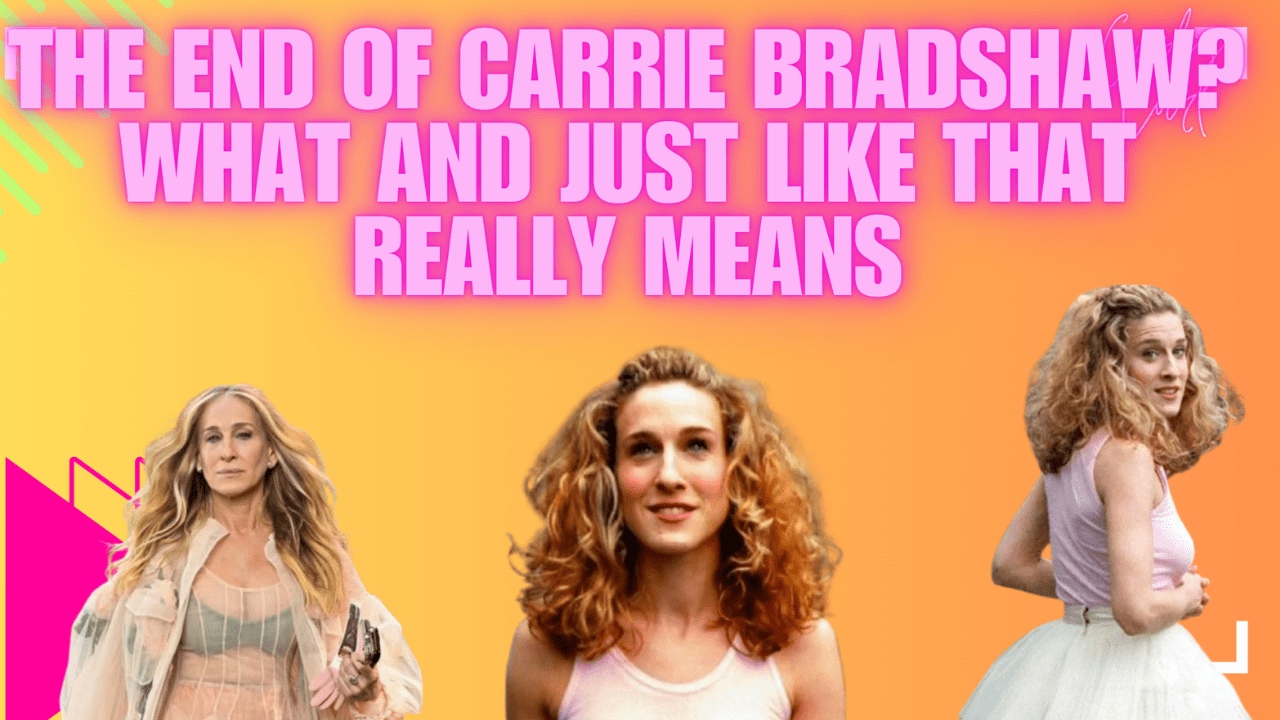
It begins with a question so deceptively small you could almost miss its weight, the kind of question that’s tossed into the air over a late-night drink but actually marks the close of an era. “What’s going to happen to the woman?” asked Duncan Reeves — Carrie Bradshaw’s urbane, politically contrarian neighbor and, for a time, her lover — as if he were asking about a mutual friend’s travel plans rather than the fate of one of television’s most enduring female protagonists. The woman, of course, is Carrie herself: the former sex columnist who spun her musings on intimacy into a cultural currency, who morphed into a podcaster, then a widow, and now, improbably, a writer of historical fiction. Her trajectory over the decades has felt at times random, at others like the only possible progression for a character whose greatest constant was unpredictability. Now, as And Just Like That edges toward the conclusion of its third season, Michael Patrick King has confirmed that two extra episodes will be tacked on — but after episode twelve, Carrie Bradshaw’s story in this form will be over. That announcement landed not with a scream but with the kind of collective sigh that blends relief, disbelief, and the dawning realization that something quietly foundational is ending. The show remains a paradox — derided for implausible plot twists one week, dissected with scholarly precision the next. Viewers laugh at the silver catsuit scene, roll their eyes at implausible real estate miracles, yet never fail to tune in. This loyalty isn’t about plot mechanics; it’s about a generational relationship to a fictional woman who, since her HBO debut in 1998, has served as a template, a mirror, and sometimes a warning sign for those trying to write their own adulthood in real time.
When Sex and the City first hit the screen, Millennials were perched at the brink of something — graduating, moving into their first apartments, learning to email and date online in the same breath. Carrie was not the kind of journalist they’d been taught to revere in school — no ink-stained war reporter, no crusading columnist holding power to account. She was something stranger and more magnetic: a chronicler of the inner life, taking the language of op-ed seriousness and applying it to questions like “Can we be friends with our exes?” or “Is it possible to cheat on your career with another dream?” She reframed the columnist as a cultural protagonist, using her Olivetti typewriter as both tool and talisman, her wardrobe as a vocabulary of identity. She didn’t just break the fourth wall by speaking to us directly — she invited the audience into a conspiratorial brunch table where sex and philosophy were served in equal measure. This was not a world of editorial objectivity; it was an unapologetically subjective lens, turning personal experience into public discourse. For Millennials raised in the shadow of taboos around sex and relationships, Carrie’s frankness was not just refreshing — it was a liberation.
She detonated the old archetype of the columnist — no longer the chain-smoking cynic in a newsroom corner, but a glamorous flâneur of the city, turning romantic failures into narrative capital. The fact that her apartment and shoe collection defied her apparent income only added to the fantasy. She became a brand before personal branding was a thing, laying the groundwork for the blogosphere, the influencer economy, and the confessional essay industrial complex. By the time social media arrived, the Carrie archetype was everywhere — the voice-driven persona, curating her own myth in real time. And what she did with intimacy was even more subversive. At the turn of the millennium, television love stories still tended to be linear morality tales. Carrie refused linearity. She showed that love could be cyclical, contradictory, incomplete. She asked questions without moralizing: What if marriage isn’t the endgame? What if desire can survive contempt? What if soulmates come in multiples and in unexpected forms? Millennials, many of whom would later delay or forgo marriage entirely, recognized something true in that openness.
That’s why the end of her story feels bigger than a plot resolution — it’s a cultural marker. The Millennial relationship to Carrie is less about aspiring to her literal life, more about believing in the possibility of reinvention she symbolizes. Even now, in her mid-fifties, she’s changing careers, questioning commitments, trying on new selves like she once tried on dresses at Bendel’s. In a television landscape that still too often sidelines older women into the roles of mother, boss, or punchline, Carrie was one of the few who remained a romantic and philosophical protagonist. Removing her leaves a gap — not just for fans, but for a broader conversation about what kinds of women’s lives are worth depicting past the “finding yourself” years.
But here’s the thing: endings in TV are rarely permanent. The syndication value alone makes it hard to believe we’ve truly seen the last of her. If there’s money, there’s usually a comeback. We could see a Sex and the City revival proper, a limited series, a streaming-exclusive movie. But imagine the more radical move — a leap ten years into the future, the camera turning to a new lead. A younger woman, perhaps a journalist but in the modern sense — running a Substack, juggling TikTok followers and a precarious rent-stabilized apartment. Maybe she’s in Paris, like Emily in Paris’s glossy chaos, but with the introspection Carrie embodied. Let’s call her Ava. She wouldn’t be a clone — she’d have her own generational questions: How do you find intimacy in a world where everything is archived? What does romance mean when your dating history is algorithmically tracked? Would love letters survive the tyranny of the text bubble? Through Ava, we might glimpse Carrie’s influence refracted through Gen Z’s lens — less about chasing the “one” and more about defining the “many” versions of self a person can inhabit over a lifetime.
And maybe — because television loves its cameos — there’d be an older Carrie, still in New York, still with a closet full of impractical shoes, now a guest star in someone else’s coming-of-age. She’d appear at a book launch or a chance café meeting, the elder stateswoman of romantic inquiry, offering a line not as advice but as provocation: “The real story isn’t who you end up with — it’s who you are when you get there.” That’s the kind of legacy a character like hers could have. It’s why she endures beyond the finale, beyond the criticisms of plot or tone.
Because Carrie Bradshaw, at her core, was never about having all the answers. She was about granting permission to ask the questions in the first place — and to do it in heels, on a city street, under the night sky, with equal parts curiosity and audacity. And just like that, maybe we realize that this isn’t really an ending at all.
 curlycurlworld: Get Twisted with CurlyCurl: The Latest in Curls, Coils, and Confidence!