
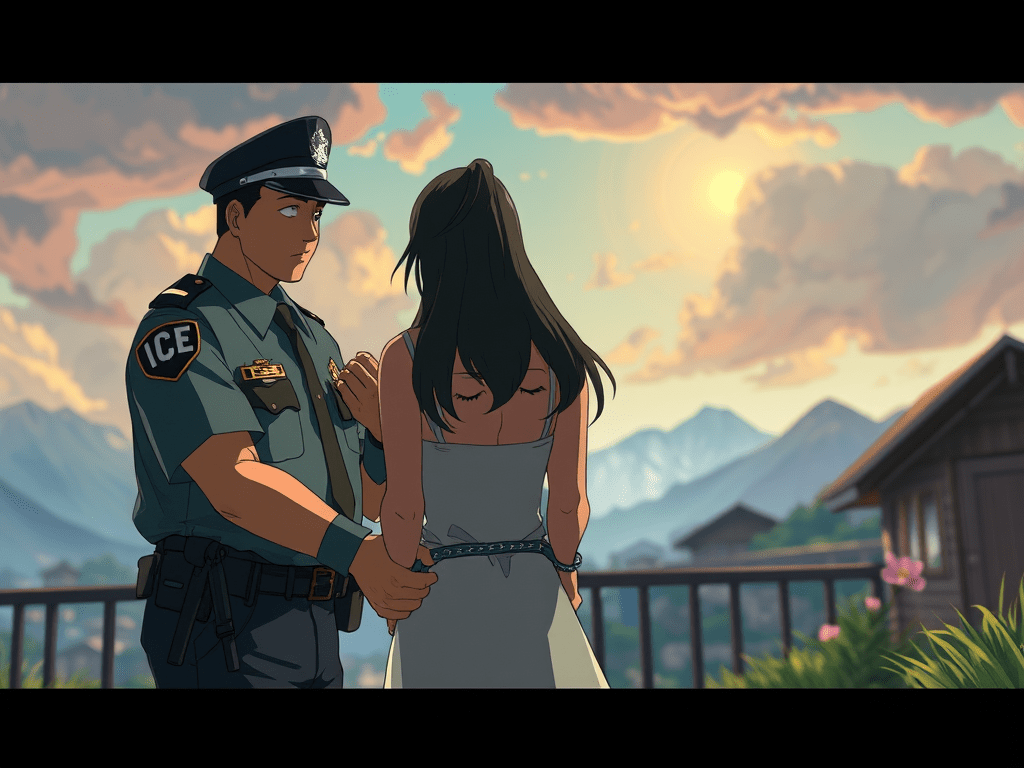
About 15 hours ago, the official White House account on X sparked controversy by posting an unsettling image: an ICE officer handcuffing a visibly distressed woman. ICE, the federal agency overseeing immigration enforcement in the U.S., has faced criticism for its role in deportations and arrests that some see as politically motivated. The arrest in question was real—Virginia Basora-Gonzalez was taken into custody ten days ago while attempting to re-enter the country, charged with trafficking illegal fentanyl. However, what drew the most outrage was not just the content of the image but its artistic style.
Rather than a standard photograph, the image was digitally altered using an AI tool called “Ghibli Magic,” a recently introduced ChatGPT feature that transforms photos into artwork reminiscent of Hayao Miyazaki’s iconic Studio Ghibli animations. The contrast was jarring: a moment of real human distress rendered in a whimsical, almost nostalgic art style. Since its release, “Ghibli Magic” has gone viral, with many users experimenting out of curiosity or sentimentality—one widely shared story in The New York Times described an American woman who was deeply moved by seeing her wedding photos transformed in this way. However, others have taken the feature in a different direction.
The White House post is perhaps the most controversial example, but the internet has seen similar AI-generated Ghibli-style reinterpretations of major historical and political events. These include depictions of 9/11, the murder of George Floyd, the heated exchange between Donald Trump and Volodymyr Zelensky in the Oval Office, and even Elon Musk at a formal dinner.
The backlash has also reignited discussions about AI in art, with many recalling Hayao Miyazaki’s well-documented disdain for artificial intelligence in animation. In a 2016 documentary, after being shown an AI-generated animation demo, the legendary director famously reacted with disgust, calling it “an insult to life itself.” Now, as AI-generated art becomes more pervasive, his words seem more relevant than ever.
Hayao Miyazaki is a masterful artist who has dedicated his entire life to the craft of animation. His work is the result of meticulous effort, deep creativity, and an unwavering commitment to artistic integrity. Seeing the name of his studio and the essence of his art reduced to a gimmicky filter—one that not only turns any photo into a casual aesthetic experiment but is also being used for political propaganda and insensitive reinterpretations of tragic historical events—is more than just a trivialization. It’s a distortion of everything Studio Ghibli represents.
Studio Ghibli’s signature style is not merely a set of visual tropes; it stems from a painstakingly handcrafted approach to animation. Every frame reflects an unparalleled attention to detail, a depth of imagination, and a subtlety in color and movement that is inseparable from the philosophy behind it. Those who truly appreciate Ghibli films understand that their magic is not the product of an easily replicated aesthetic but the result of immense dedication, creative struggle, and human touch.
The rise of AI-generated “Ghibli-style” images threatens to dilute this legacy. As motion graphics editor Fredrik B. recently noted on X, the overuse of this aesthetic risks making it feel generic, stripping it of its depth and originality. “The Ghibli style is going to become oversaturated and associated with lazy and boring content—I can’t wait for kids to grow up thinking Ghibli movies are generated by AI when they’re actually created by excellent artists,” he warned.
Beyond artistic concerns, there are ethical and legal questions at play. Naming an AI tool after a studio that pioneered this distinctive style—without its consent—raises potential copyright issues. Whether legally permissible or not, the idea that Ghibli’s artistry is being repurposed for viral memes and even extremist political content feels fundamentally wrong. Yet, as this technology spreads rapidly online, objections seem to be drowned out by its popularity.
Sam Altman, the creator of ChatGPT and yet another polarizing billionaire from Silicon Valley, responded to the controversy with a joke. He quipped that he had spent a decade working on artificial superintelligence “to cure cancer and things like that,” only to wake up one day bombarded with messages like, “Look, I turned you into a Ghibli twink haha.” While his remark was meant to be lighthearted, it did little to quell the growing criticism of AI’s role in reshaping creative industries—and, in some cases, outright exploiting them.
Beyond the humor, a far more serious conversation is unfolding about AI, copyright, and global competition. A quote attributed to Altman—though actually from a recent U.S. policy proposal—paints a stark picture of the stakes involved: “If Chinese developers have unlimited access to data, and American companies are left without access to fair use, the AI race is essentially over. America loses, as does the success of democratic AI.”
As Futurism reports, OpenAI argues that without the ability to scrape and utilize copyrighted material, the U.S. risks falling behind China in AI development. This stance has led OpenAI to advocate for changes to “fair use” laws, a move that has drawn significant backlash. According to Ars Technica, Altman and his company are now lobbying Donald Trump’s camp to push for federal regulations that would redefine fair use in their favor—a particularly controversial position given the ongoing lawsuits from The New York Times and other publishers. These legal battles stem from allegations that OpenAI trained its models using copyrighted materials without consent, including works from journalists, artists, and filmmakers—ranging from Hayao Miyazaki to the creators of South Park.
The debate highlights a fundamental question: Should AI companies be allowed to repurpose existing creative work to fuel their advancements, even when the original artists and authors never agreed to it? While OpenAI presents this as a matter of national security and technological progress, critics argue that it’s simply a high-stakes case of corporate overreach—one that could reshape copyright law in ways that benefit AI giants at the expense of human creators.
The core argument driving this debate is the fear that Chinese AI models like DeepSeek—faster and cheaper—could outpace American companies in the so-called “AI race.” But this competition brings with it a major ethical dilemma: AI models frequently generate responses that come dangerously close to outright copyright infringement.
Sam Altman’s proposed solution is to redefine the legal concept of “fair use,” framing it as a matter of national security. However, there’s a clear contradiction in his stance. OpenAI has previously accused DeepSeek of using its data without permission, yet this concern is conspicuously absent from the push for fair use reform—likely because acknowledging it would undermine the company’s own argument.
This dilemma is particularly thorny because AI is undeniably a valuable tool across many fields, from scientific research to technological innovation. Yet the “Faustian bargain” that comes with its creative applications is hard to ignore: in exchange for powerful, accessible technology, AI absorbs and automates the skills of countless artists, turning human creativity into little more than an algorithmic process.
Some argue that AI-generated art and writing democratize creativity, making artistic expression more accessible. But in reality, this approach reduces art to a novelty—a disposable, low-effort filter applied for entertainment rather than a meaningful form of human expression. The result is an artistic landscape flooded with generic, derivative content, devoid of the struggle, refinement, and originality that define true craftsmanship.
In a perfect world, AI would handle tedious, repetitive tasks so that people could spend more time creating. But the trajectory we’re on suggests a far more dystopian outcome: one where humans are stuck performing monotonous labor while machines generate the paintings, music, and poetry that once defined human culture. To borrow from a popular meme, the ideal future isn’t one where AI makes art so people don’t have to—it’s one where AI frees people to make art.
 curlycurlworld: Get Twisted with CurlyCurl: The Latest in Curls, Coils, and Confidence!