
Since the emergence of artificial intelligence language models, OpenAI has secured a dominant position in the AI space. They have established near-total control over public use. In just over two years, ChatGPT has become an indispensable tool for many. It serves as a personal assistant, work companion, and even a virtual therapist. Despite efforts by other tech giants like Google with their Gemini model, ChatGPT’s intelligence remained unmatched — until recently.
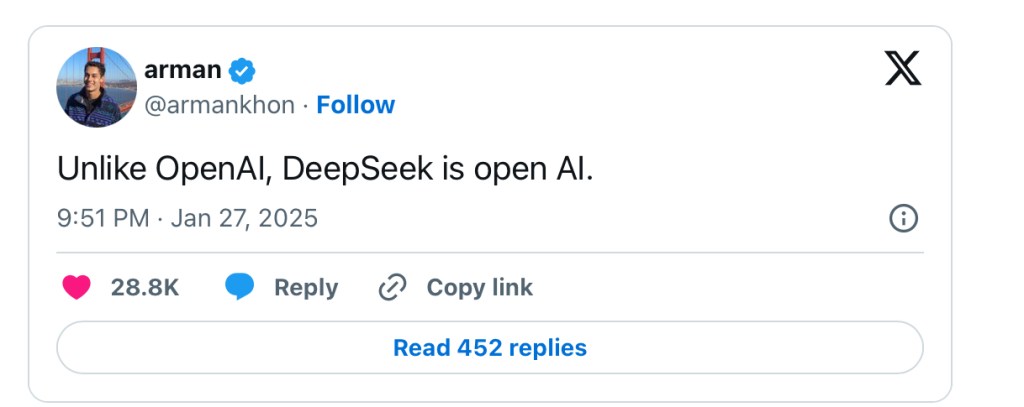
In a stunning move last week, a new AI chatbot from China, called DeepSeek, emerged. This development occurred during the first week of Donald Trump’s presidency. It happened right after the failed TikTok ban in the U.S. DeepSeek offers significantly lower costs compared to Western counterparts. It also outperforms ChatGPT’s older version. Until earlier this year, that was considered the best available. So, how did DeepSeek achieve such rapid advancement? The Chinese startup opted to make its AI open-source, sharing the underlying code with other companies and researchers. This open approach allows third parties to create their own products. They can distribute these products based on the same technology. This process enables faster adoption at lower prices. Within just one week of its launch, DeepSeek’s app surpassed ChatGPT in mobile downloads. One reason is its most advanced model, DeepSeek V3, is freely available to everyone.
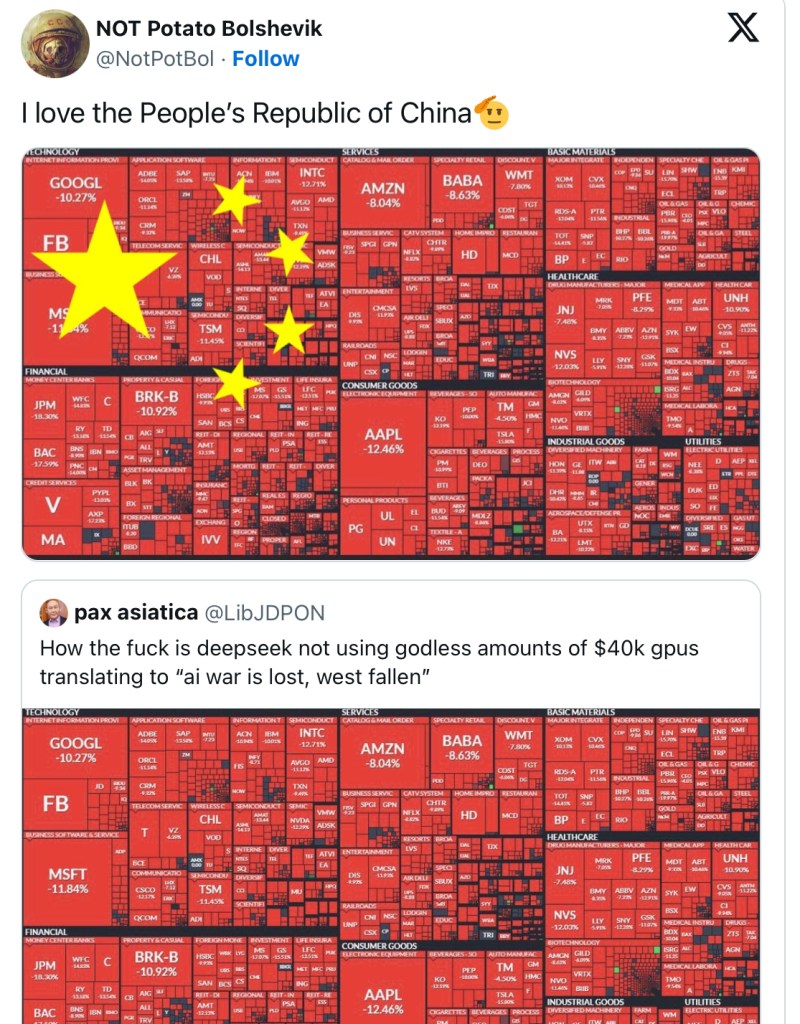
DeepSeek’s AI stunned the tech world with its cutting-edge innovation. It also caused a dramatic upheaval in the global hardware market. A research paper from the DeepSeek team reported on the Chinese startup’s AI training methods. They reportedly used only 2,000 Nvidia chips. This is a fraction of the typical 16,000 chips used by leading tech companies. This more efficient approach resulted in significantly lower costs. The development of DeepSeek’s V3 model cost around $6 million. This was a stark contrast to the billions spent by its competitors. This breakthrough triggered a chain reaction that caused a massive crash in the stock market. On January 27, the New York Times reported that Nvidia saw a staggering $600 billion drop in its stock value. This was the largest single-day loss in its history. Nvidia is the key supplier of chips for most AI systems. Other chip manufacturers, such as Micron and Broadcom, also experienced losses of more than 10%. Major tech companies were not immune either. These include Alphabet, Microsoft, Meta, and Apple. Their stocks fell between 2% and 4%. Virtually every major trade closed in the negative.
The emergence of DeepSeek coincides with a tense political environment, especially between the United States and China. This comes just a week after the U.S. Senate debated a potential ban on TikTok, accusing the app of sharing user data with the Chinese government. During a press conference on Monday, newly-elected President Donald Trump made a remark. He said DeepSeek’s rise should act as a “wake-up call” for American tech companies. He emphasized that if China could develop such a sophisticated AI model at a lower cost, it’s a “win.” This would greatly benefit the U.S.
As a Chinese-developed AI, DeepSeek has faced scrutiny. Critics cite potential cognitive biases, especially in areas sensitive to the Chinese government. Users have noted the AI’s responses to politically charged topics. These include the Chinese Communist Party and historical events that are censored in China. For example, when asked about Taiwan, the AI asserted, “Taiwan is historically and legally an inalienable part of China.” It claimed this is a general consensus of the international community. The Chinese government adheres to the One China principle and resolutely opposes any form of secessionist attempts or ‘Taiwan independence.’” The AI addressed the Israeli-Palestinian conflict more neutrally. It stated, “China supports the just cause of the Palestinian people. It supports them in restoring their legitimate national rights. It supports the establishment of an independent Palestinian state through peaceful negotiations and the two-state solution.” The contrast in these answers highlights the AI’s alignment with Chinese political narratives. This raises questions about its neutrality. It also raises questions about its influence.
DeepSeek-V3 marks a significant milestone in the development of artificial intelligence. This is not only due to its technological sophistication but also because of its broader economic and geopolitical effects. The AI model has proven capable of solving complex problems. It answers inquiries and generates code. It competes effectively with the top systems available. Established benchmarks confirm its performance. Despite its rapid success, experts have pointed out some shortcomings. For instance, DeepSeek’s design does not prioritize reasoning through highly intricate problems. This is an area where OpenAI’s O3 model appears to hold an edge. OpenAI has not released its newer system to the public yet. It opts for a more measured and cautious approach compared to DeepSeek’s open-source model.
DeepSeek’s decision to make its technology open-source has stirred considerable debate. According to the New York Times, this move has fueled innovation. It promotes faster adoption and allows for the model to be customized by others. Yet, it has also raised concerns about the potential security risks of such an approach. Many U.S. experts and lawmakers worry that this openness could lead to the spread of misinformation or other security threats. On the other hand, some argue that restricting open-source technology in the U.S. could inadvertently give China a competitive advantage, compelling American companies and researchers to adopt Chinese technologies. Ultimately, further evaluation of the upcoming release of the new ChatGPT model will be necessary before drawing final conclusions.
 curlycurlworld: Get Twisted with CurlyCurl: The Latest in Curls, Coils, and Confidence!