
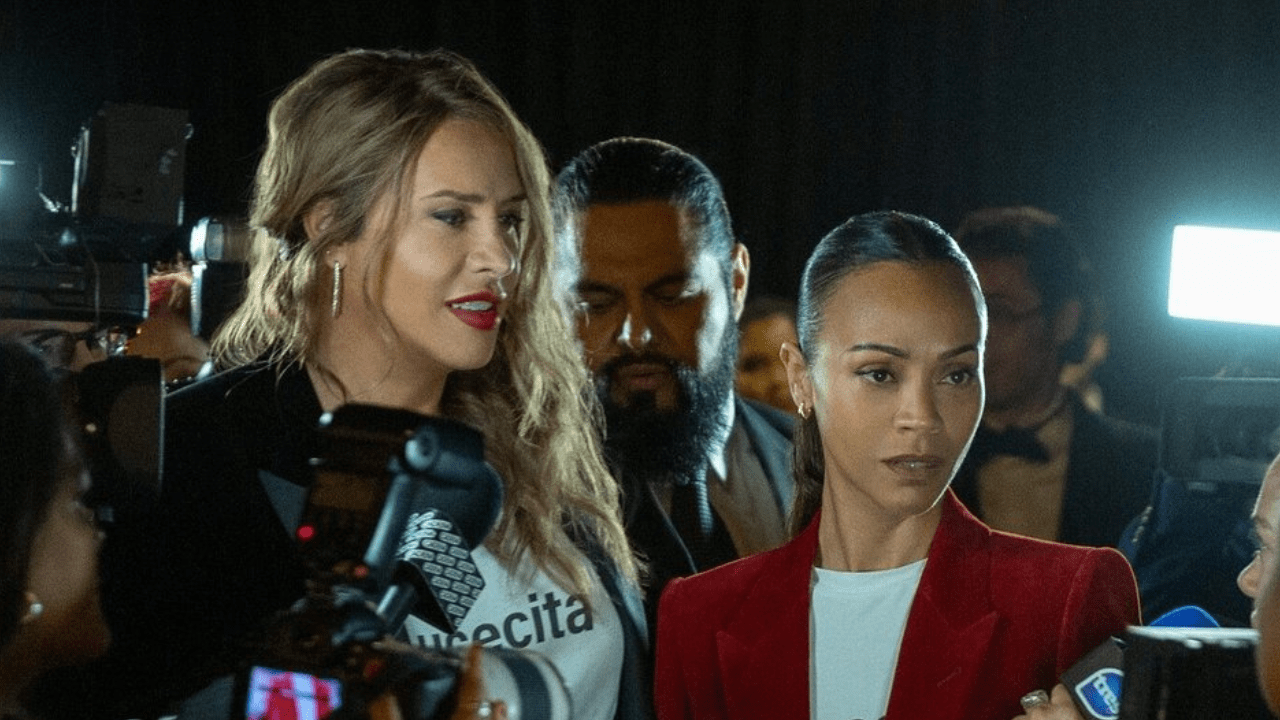
As lawyer Rita Moro Castro powerfully declares in the film, Zoe Saldaña portrays a bold character in Emilia Pérez. The line “Habla, esta gente habla, pero ahora lo van a pagar, a pagar, a pagar…” is particularly striking. This comes from El mal, one of the original songs in Jacques Audiard’s gangster-musical. It resonates beyond its immediate context. The character addresses a group of unscrupulous businesspeople. It feels equally fitting as a commentary on the controversies surrounding the movie in recent months. The movie dominates the awards circuit. It has won the Golden Globe for Best Musical or International Film. Despite such accolades, the film has faced sharp criticism, reflected in its 2.8-star rating on Letterboxd, and reignited debates on social media.
The backlash stems from its depiction of Mexico. The story unfolds there with a former cartel boss embracing their true self. They transition into a woman. Critics argue the movie lacks authenticity in its portrayal of Mexican culture, from its superficial settings to the casting choices. Notably, Mexican singer and actor Mauricio Martínez criticized director Jacques Audiard. He stated the French filmmaker “has never set foot in Mexico.” Martínez added that Audiard publicly admitted he didn’t need to do research. This, Martínez claims, reduces Mexico to shallow stereotypes, trivializing the country’s complex identity and struggles.
The film’s plot has faced significant criticism for its portrayal of sensitive issues. These include drug trafficking and the crisis of missing persons in Mexico. These topics are deeply tied to the country’s ongoing struggles. Critics argue that these themes lack depth and respect. They reduce serious national crises to superficial plot devices. Mexican journalist Luis Pablo Beauregard wrote for El País. He remarked that the film’s most egregious failure is its frivolous treatment of Mexico’s tragic epidemic of missing persons.
Adding to the controversy is the fact that Mexico itself was used as a filming location for just five days. The majority of the movie was shot in French studios in Bry-Sur-Marne. This decision underscores the film’s detachment from the culture it seeks to portray. The casting choices have also drawn ire. The three lead actresses—Zoe Saldaña, Karla Sofía Gascón, and Selena Gomez—lack Mexican heritage. The sole Mexican actress in the cast, Adriana Paz, plays a supporting role as Epifania Flores.
Carla Hool, a prominent Mexican casting director, explained that she initially aimed to cast an all-Mexican ensemble. She expanded her search to other Latin American countries when she couldn’t find what she was looking for. However, this justification has only intensified the backlash. Many see it as another indication of the film’s disconnect from its cultural roots.
In Emilia Pérez, the roles of Zoe Saldaña, Selena Gomez, and Karla Sofía Gascón were adapted in the script. This was done to account for their varying accents. Saldaña is a U.S. actress of Dominican and Puerto Rican descent. Gomez’s father is Mexican. Both were given adjusted dialogue. Meanwhile, Gascón, the lead, hails from Spain. Despite these efforts, accents and pronunciation sparked heated debates. The trio shared the Best Female Performance award at the 2024 Cannes Festival. This recognition failed to quell the criticism surrounding their performances.
Selena Gomez, in particular, faced the harshest backlash. Actor Eugenio Derbez and host Gaby Meza dissected Gomez’s portrayal of Jessi Del Monte in an episode of the Spanish podcast Hablando de Cine. Derbez bluntly remarked, “She’s indefensible. Every time her scene came on, we’d look at each other and say, wow, what is this?” Meza added, “Spanish isn’t her first language, nor her second—I fear it’s not even her fifth. Her performance felt not only unconvincing but embarrassing.”
Gomez lost fluency in Spanish at a young age after moving from Texas to California. She relearned the language in just six months to prepare for the role. Responding to the viral podcast clip, Gomez addressed the criticism in a TikTok video, saying, “I understand your opinion. I’m sorry—I did what I could with the time I was given. That doesn’t take away from all the work and heart I put into the film.” Following her response, Gaby Meza publicly apologized for her comments.
The portrayal of the trans lead character in Emilia Pérez, directed by a cisgender male filmmaker, has sparked mixed reactions. The casting of Karla Sofía Gascón is considered a step forward for inclusion. She is a trans actress in the entertainment industry. However, the film still faced significant criticism. Gascón’s Cannes award was celebrated as a milestone. She shared this award with co-stars Zoe Saldaña and Selena Gomez. Yet, concerns about the movie’s handling of transgender representation persisted.
GLAAD (Gay & Lesbian Alliance Against Defamation) criticized the film, calling it a “profoundly regressive depiction of a trans woman.” This assessment contributed to the ongoing debate. People discussed whether the film truly advances LGBTQIA+ narratives. They also considered if it perpetuates harmful stereotypes.
Despite these controversies, Emilia Pérez has been making strides during awards season. She appears to be on a steady path toward an Oscar campaign. However, in the volatile landscape of Hollywood, such backlash could present a formidable obstacle as the race intensifies.
 curlycurlworld: Get Twisted with CurlyCurl: The Latest in Curls, Coils, and Confidence!