
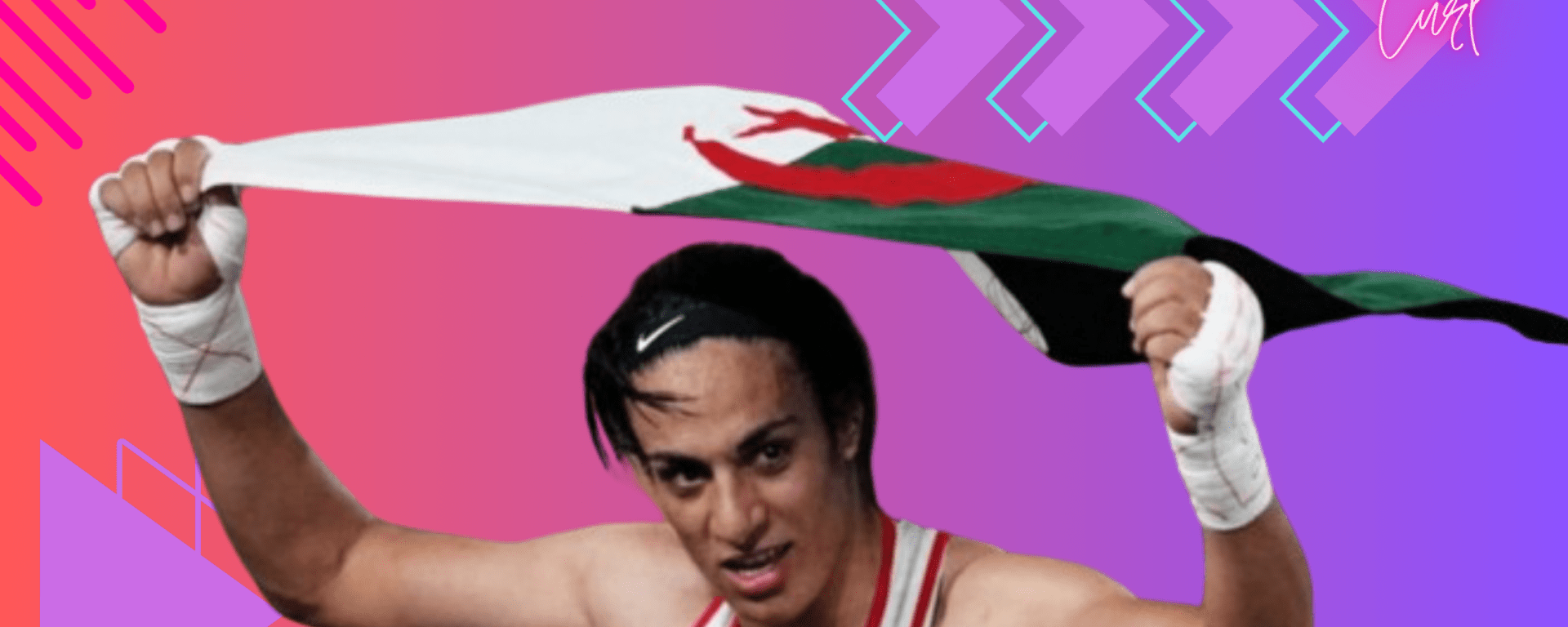
Before the Games, Imane Khelif was a name known only to boxing enthusiasts. but, the 2024 Olympics have brought her into the global spotlight. These Games will be remembered not just for the fierce competition but for the incredible journey of Khelif, the intersex boxer who has become the focal point of a heated debate. Her gold medal win in the women’s welterweight boxing category (-66 kg) has etched her name in history.
The 25-year-old Algerian athlete secured a decisive victory in Paris, defeating China’s Liu Yang in the final by winning all three rounds on points. This victory not only marks Khelif’s rise to prominence but also gives Algeria its first-ever boxing gold medal.
Khelif’s triumph comes after a tournament overshadowed by controversy surrounding her physical characteristics. The debate began with her contentious debut against Italy’s Angela Carini, who exited the ring after just 46 seconds and two punches, fueling discussions on the perceived masculinity of Khelif. Despite the controversies, Khelif’s skill and determination have solidified her place in Olympic history.
Imane Khelif was born on May 2, 1999, in Tiaret, Algeria. Despite facing resistance from her family, she always harbored dreams of excelling in boxing. At 17, inspired by watching the Rio 2016 Games on television, she decided to pursue a career in the sport.
Khelif made her mark with a promising debut at the 2018 World Championships, finishing 17th. This was followed by her participation in the Tokyo 2021 Olympics, where she earned the title of Best Algerian Athlete.
Her career,, took an unexpected turn at the 2023 World Championships in New Delhi, where she, along with Taiwanese boxer Lin Yu-ting, was disqualified by the International Boxing Association (IBA) due to elevated testosterone levels and the presence of male chromosomes. A karyotype test conducted by the IBA confirmed these findings, revealing that both athletes had male chromosomes. Despite this setback, Khelif was allowed to compete in the Paris 2024 Olympics, where she defied all odds to claim the gold medal.
The controversy surrounding Khelif began with a blood test in 2022, which revealed abnormalities later confirmed in 2023 by Fillipatos, the president of the IBA medical committee. Meanwhile, the former IBA president, Kremlev, sparked further outrage by offering Angela Carini, Khelif’s opponent, a €100,000 prize, suggesting she should have been recognized as the Olympic champion, thereby undermining the IOC’s authority.
The public and media quickly picked up on the debate, which exploded worldwide after Khelif’s quick victory over Carini. Social media and television programs were flooded with discussions about Khelif’s condition, with many public figures, including celebrities and politicians, weighing in. Unfortunately, much of the discourse was marked by derogatory labels, as Khelif was unfairly called names like “man,” “trans,” and even “
As tension built up, Imane remained seemingly unfazed, protecting herself with her gloves. However, after securing a unanimous victory in the quarterfinals against Hungarian opponent Hamori—who later took to Instagram to make pointed remarks—Imane released her emotions in a triumphant cry.
Embraced by her coach and draped in the Algerian flag, the North African athlete left the ring in tears, pausing only to share a few words with SNTV:
“Bullying must end; its impact is devastating. My family back home in Algeria is deeply concerned. I hear about the issues twice a week and hope they aren’t too hurt by it all. Winning gold would be the best response I could give. I urge everyone to uphold the values of the Games, as outlined in the Olympic Charter. We must reject bullying in all forms—it can destroy lives, crush spirits, and divide people.”
In the semifinals, Imane once again secured a unanimous victory against Thailand’s Suwannapheng, followed by a final three-round win against China’s Liu Yang. Yet, even before her gold medal win, the 25-year-old was already a beloved figure among Algerians. In Paris, she had become a national heroine, a symbol of women’s empowerment and diversity, leading her people not just in a sports competition but in a broader struggle for rights that they now proudly champion.
Imane has always confidently identified as a woman, never questioning her gender identity. However, she faces the challenge of living with hyperandrogenism, a condition that causes her endocrine glands to produce higher-than-average levels of male hormones like testosterone.
This condition raises a controversial question within the boxing community: Is it fair for her to compete against other women? The International Boxing Association (IBA), which barred her from the last World Championships and continues to refer to her as ‘a man,’ argues that it isn’t. On the other hand, the International Olympic Committee (IOC) supports her right to compete. Imane’s gold medal victory was well-earned, and it’s important to note that her success in the ring is not solely due to elevated hormone levels, which are managed through specific medical treatments. Ismael Bennacer, an Algerian footballer for AC Milan and a UNICEF ambassador for Algeria, also expressed his support for Imane by sharing a joint statement on social media.
 curlycurlworld: Get Twisted with CurlyCurl: The Latest in Curls, Coils, and Confidence!