
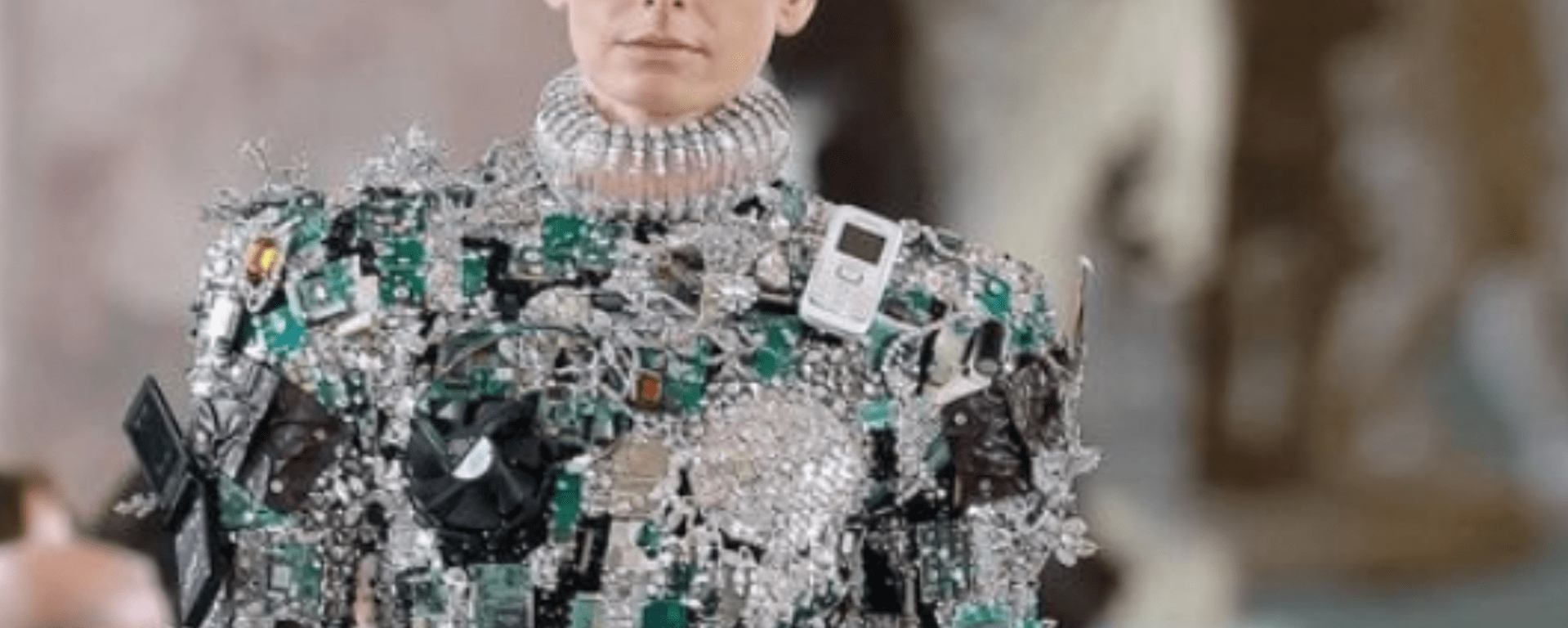
Daniel Roseberry’s SS2024 Collection Unveils a Cosmic Fusion, Blending Schiaparelli’s Elegance with Martian Inspirations and Technological Marvels
In a spectacular convergence of luminaries like Robin Givan, Zendaya, and Hunter Schafer, Daniel Roseberry orchestrated a mesmerizing runway show that seamlessly fused Hollywood’s allure with the precision of haute couture. The models, adorned in feathers and skeletal contours, revived Elsa Schiaparelli’s iconic stylistic imprints—exploring human anatomy and surrealism. Yet, Spring Summer 2024 saw a bold leap into the extraterrestrial, as Roseberry drew inspiration from his uncle, coiner of the term “martian.”
The collection marveled at the cosmic with a motherboard and microchip dress adorned with “technological artifacts predating 2007,” alongside a doll composed of electronic panels, pearls, and Swarovski, cradled by Maggie Maurer in pristine white. The cyborg aesthetic, elevated to unprecedented elegance, harkened back to the avant-garde of 1999. Amidst Y2K fears and the specter of a technological apocalypse, designers ventured into uncharted territories, birthing the enchanting yet unsettling allure of robots.
Welcome to the era of cyborg-couture, where transcending one’s corporeal form unveils a new, ethereal embodiment, echoing the past while propelling fashion into an exhilarating future.
In 1999, as the world stood on the cusp of a new era defined by the burgeoning internet, fashion collections echoed a palpable fear of technological advancement. Givenchy’s FW99, inspired by Blade Runner’s metallic aesthetic, showcased Alexander McQueen’s vision of cybernetic relationships through brutalist uniforms and models immersed in luminous circuits—a striking reflection of society’s unease.
John Galliano, in his Dior collection that year, seamlessly intertwined historical references with inspiration drawn from The Matrix, unveiling a tapestry of style echoing both past and future. Simultaneously, Hussein Chalayan’s forward-thinking incorporation of robotic panels into the iconic airplane dress heralded a new era in fashion.
This prophetic narrative was not confined to fashion alone. In the music industry, Björk, a true visionary, released the award-winning music video “All Is Full of Love” in 1999. Here, she portrayed a love-struck robot, foreshadowing the intersection of humanity and technology.
Fast forward to contemporary brands like Coperni, where technology has become a stylistic code. The prescient innovations of Givenchy, Dior, and Chalayan in 1999 anticipated the very essence of what would eventually be deemed the fashion of tomorrow, shaping a landscape where creativity and technology seamlessly converge.
While the media content and collections of 1999 hinted at a futuristic trend, the recent portrayal of cyborg beings on runways has been more about aesthetics than a profound societal shift. The evolution began with Fendi’s FW14, where drones made their runway debut, capturing the event from unique angles. Dolce&Gabbana took it a step further in FW18, turning drones into models, blurring the lines between technology and fashion.
Karl Lagerfeld, always a pioneer, envisioned Chanel’s iconic tweed jackets adorning characters in gleaming white metal for SS17. Dior Men’s Pre Fall 2019 left audiences in awe with a colossal female robot as a central figure, showcasing a breathtaking fusion of fashion and technology.
Fast forward to 2021, where Frank Ocean’s Met Gala entrance featured a green puppet, a creative spectacle designed to promote his new brand, Homer. Then, in 2023, Coperni disrupted norms by incorporating Boston Dynamics’ robot dogs into the runway, creating an interactive and futuristic display that resonated with the spirit of the times.
While the cyborg trend may have originated as a mere aesthetic fascination, it has undeniably evolved into a dynamic fusion of fashion and technology, pushing the boundaries of creativity on the runway in unexpected and captivating ways.
Alessandro Michele’s proclamation following the FW18 Gucci runway show resonates as a manifesto for a post-human era, where the act of reproduction takes a back seat to a profound exploration of existence. This collection, a pinnacle of Michele’s artistic tenure, transcends mere fashion; it’s a narrative woven through garments, casting choices, makeup, and subtle technological nuances, illustrating humanity’s role as the Dr. Frankenstein of its own existence.
The underlying concept, drawn from Donna Haraway’s Cyborg Manifesto, finds resonance in Lady Gaga’s Born This Way era—a testament to the enduring influence of philosophical ideas on creative expression. Michele and Roseberry’s cyborgs transcend being mere visual objects; they emerge as symbolic tools, a stark departure from brands viewing robots solely through a superficial lens.
Just as high fashion has historically provided a portal to alternate realms, Schiaparelli’s aliens, showcased in this avant-garde collection, challenge societal constraints and liberate our imagination. The once-feared cybernetic reality is no longer a source of trepidation but rather a transformative costume, granting entry into the uncharted world of haute couture. In this narrative, the runway becomes a gateway, not just to trends but to a redefined reality—one where the fusion of humanity and technology heralds a new and liberating frontier.
 curlycurlworld: Get Twisted with CurlyCurl: The Latest in Curls, Coils, and Confidence!