
Exploring Maria Grazia Chiuri’s Dior SS24 Collection and the Ongoing Debate in High Fashion
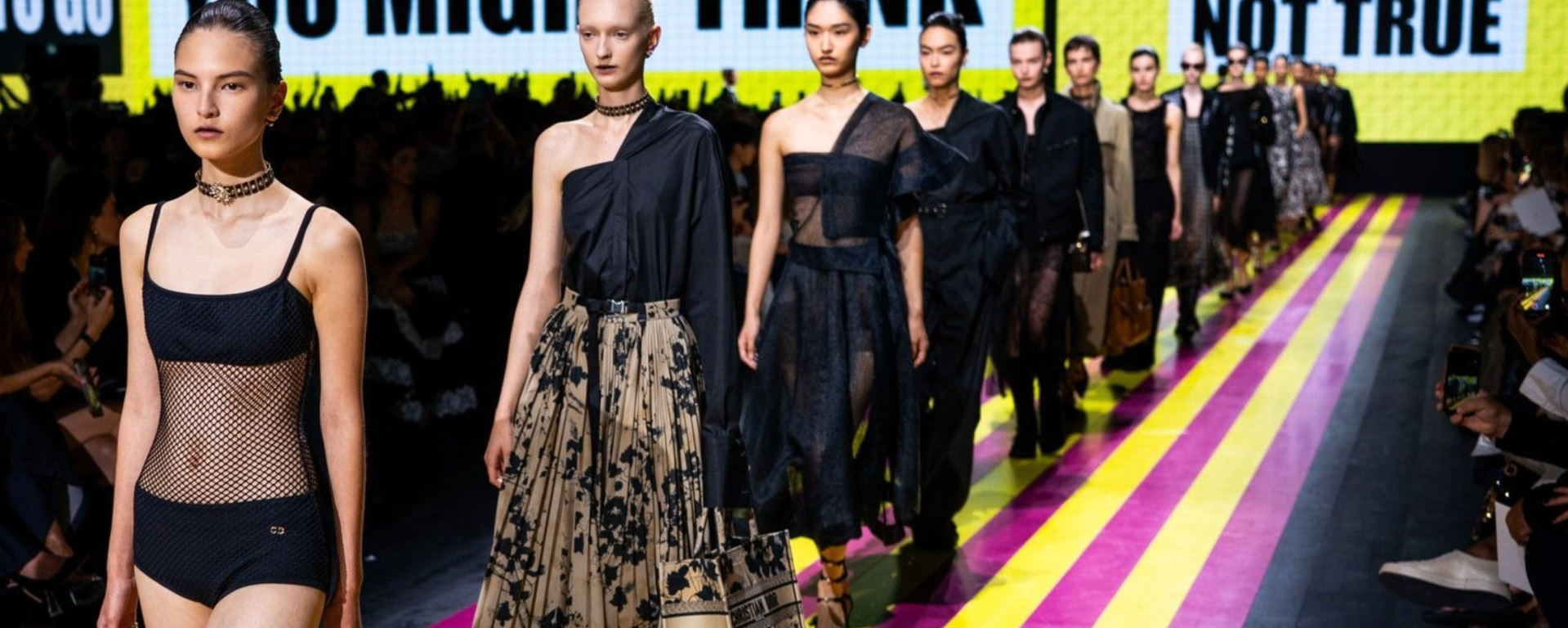
On the vibrant second day of the illustrious fashion week, Maria Grazia Chiuri, the visionary creative force behind Dior, unveiled her much-anticipated Spring-Summer 2024 collection. In a delightful departure from convention, Chiuri’s creative genius seamlessly merged with the artistry of Italian luminary Elena Bellantoni, whose masterful curation gave birth to an awe-inspiring set-installation known as “Not Her.”
This mesmerizing exhibition bore witness to two profound statements that reverberated through the hearts and minds of all attendees. The first, “Capitalism won’t take her where she really wants to go,” served as a stark reminder of the ever-persistent debate surrounding capitalism, beautifully juxtaposed within the opulent surroundings of a luxury brand affiliated with one of the world’s most colossal capitalist entities. It was a poignant commentary, a reflection on the paradox that exists when critiquing capitalism amidst the very world it thrives in.
The second statement, “Our individual and collective transformation takes place in a radical and creative space,” resounded with a profound depth, prompting contemplation on the true meaning of “radical chic” — a concept where individuals, often privileged by society’s standards, advocate for social change. It was a call to question whether such radicalism can genuinely bring about change when rooted in privilege.
In recent times, declarations of anti-capitalism have become increasingly voguish. Fashion luminaries like Demna, the creative mind behind Balenciaga, openly admitted to their socialist inclinations, echoing a broader societal shift towards ideals of justice and equity. Yet, the irony persists: many who champion these ideals with fervor in the public sphere continue to support dystopian capitalist behemoths with their consumer choices.
The poignant question lingers: Can anti-capitalist fashion authentically exist? It is a conundrum that challenges the very essence of fashion’s role in our evolving social fabric. As the world grapples with these paradoxes, the runway remains a canvas where artistry and ideology dance in intricate harmony, beckoning us to ponder the complexities of our modern era.
In the hallowed pages of “The Capital,” Karl Marx cast a critical gaze upon what he famously termed “the murderous, meaningless caprices of fashion.” In doing so, he laid bare the early mid-19th-century underbelly of the industry, denouncing the profligate waste and its toll on the toiling masses. The burgeoning fashion realm exacted a heavy toll on the household economies of countless families, where the erratic, anarchic production methods of the time meant that seasonal laborers, often clad in tatters, wove the opulent silk garments for the elite.
Werner Sombart, another luminary economist of the 19th century, went a step further, characterizing fashion as “capitalism’s favorite child.” His astute observation echoed through the ages, underlining the symbiotic relationship between capitalism and couture. The ceaseless chatter surrounding issues of overproduction, exorbitant pricing, worker exploitation, and the inordinate burden imposed upon the Global South merely bolstered this claim.
Tansy Hoskins, the erudite author of “Stitched Up: The Anti-Capitalist Book of Fashion,” minced no words in a revealing interview with Refinery29. She sagely articulated, “Fashion brands are not people; they don’t harbor personalities, hopes, or dreams. They are corporate behemoths singularly driven by one objective: to outshine their competitors and amass wealth. Social change, one must understand, shall never emanate from the bowels of fashion corporations. To harbor such a belief is to be profoundly misled.”
In 2007, the venerable Suzy Menkes, writing for the International Herald Tribune, raised a pointed query regarding Vivienne Westwood, a designer renowned for her anti-capitalist stance. Menkes questioned, “How dare she send forth a collection rife with anarchist messages, take her bow in a form-fitting dress emblazoned with the word ‘propaganda,’ announce that her show embodies the notion that ‘the more you consume, the less you think,’ and then seize the moment to launch her collection of punk safety pins adorned with diamonds?” Westwood’s retort was characteristically candid, “I do not feel inclined to vigorously defend my fashion, save for this: people are not compelled to purchase it. Consumption is an inevitable facet of life. If one possesses the means to indulge, then it’s rather splendid to acquire something from my repertoire.”
In the annals of fashion’s tumultuous relationship with capitalism, these voices resonate, each offering a distinct perspective on the interplay of opulence and ideology in a world where clothing becomes more than mere fabric; it becomes a mirror reflecting the complexities of society’s ever-evolving ethos.
In the realm of liberalism, it can be contended that every company enjoys the autonomy to promote its products as it deems fit. The weight of ideological choices then gracefully descends upon the discerning shoulders of the ultimate consumer. It is they who may choose to embrace or eschew these ideals, be swayed by their influence, or perhaps even remain blissfully apathetic while investing their hard-earned money. Indeed, the quintessential luxury patron, the archetype of Dior’s clientele, may not find themselves mired in the intricate web of subtle political and philosophical debates when stepping into the opulent boutique. These individuals, by virtue of their affluence, are active participants in the capitalist tapestry, for they possess the means to indulge in luxury.
A universally acknowledged truth, however, lies in the contemporary transformation of ideology into a marketable product. This metamorphosis has rendered even the most potent ideologies banal, reducing them to mere slogans emblazoned on T-shirts. Take, for instance, the iconic Che Guevara T-shirt—a symbol that not only endured but thrived within the very economic system it aimed to challenge.
Yet, who among us can genuinely lay claim to being staunchly anti-capitalist in today’s intricate socio-economic fabric? To varying degrees, we all partake in this system, our political discourse often mired in antiquated divisions between the “right” and the “left,” reminiscent of the bygone era of the Berlin Wall. Thus far, neither the fashion industry nor any purported cultural producer has managed to propel this discourse beyond the confines of political echo chambers.
If luxury aspires to cultivate culture and champion the arts, it should, at the very least, wholeheartedly embrace its chosen ideologies or opt for an art and culture devoid of such entanglements. The peril lies in becoming a beacon for one’s ideas akin to standing out solely for one’s choice of handbag. In such a milieu, ideology becomes a conveniently interchangeable accessory, a far cry from the earnest convictions it once represented.
1.  Case Study: Che Guevara T-Shirt
•   Author: Walter LaFeber
•   Book: “Michael Jordan and the New Global Capitalism”
•   Description: Walter LaFeber’s book delves into the global reach of American capitalism and discusses how even icons of anti-capitalist movements, like Che Guevara, have been commodified as symbols of rebellion and sold as fashionable items.
2.  Case Study: Luxury Fashion Brands and Ideology
•   Author: Tansy Hoskins
•   Book: “Stitched Up: The Anti-Capitalist Book of Fashion”
•   Description: Tansy Hoskins explores the capitalist underpinnings of the fashion industry, discussing how luxury fashion brands engage with and sometimes co-opt political and ideological messages for marketing purposes.
3.  Case Study: Vivienne Westwood
•   Author: Vivienne Westwood
•   Book: “Get a Life: The Diaries of Vivienne Westwood”
•   Description: In her own words, Vivienne Westwood, a renowned fashion designer with anti-capitalist views, offers insights into her career and her approach to fashion, politics, and activism.
4.  Case Study: Ethical Fashion
•   Author: Safia Minney
•   Book: “Slave to Fashion: What You Can Do to Stop Modern-Day Slavery”
•   Description: Safia Minney discusses the fashion industry’s social and environmental impact and highlights the rise of ethical fashion brands that aim to challenge the prevailing capitalist model.
5.  Case Study: Fast Fashion
•   Author: Elizabeth L. Cline
•   Book: “Overdressed: The Shockingly High Cost of Cheap Fashion”
•   Description: Elizabeth L. Cline investigates the fast fashion industry, shedding light on its disposable nature and the exploitation of workers, raising questions about consumerism and capitalism.
 curlycurlworld: Get Twisted with CurlyCurl: The Latest in Curls, Coils, and Confidence!
One thought on “Fashion’s Paradox: The Intersection of Luxury and Anti-Capitalism”