
Barbie better watch out—a new doll has arrived.
A doll war is approaching. The comeback of pink, the planned live-action film adaption starring Margot Robbie, and the Barbiecore aesthetic have all helped Barbie set trends thus far, but Polly Pocket, another plastic childhood icon, may soon challenge Barbie’s dominance.
Let’s go back to 1983, when a certain Chris Wiggs created a doll that could fit in a pocket and a micro-house from an old compact while searching for a new toy for his daughter Kate. In 1989, the first Polly Pocket toy was introduced, including plastic boxes in various designs, including hearts, shells, and diamonds. Each case had a secret, brilliant inside with working elements that could be unlocked. Bluebird Toys, a British business, purchased the license after seeing the brand’s commercial viability. When the first Polly Pockets were released in 1989, they delighted countless young girls who wanted to collect the tiny dolls and all of their homes, from the more elaborate to the heart-shaped ones. The company that owned the brand was sold to Mattel in the late 1990s. Mattel revamped the original Polly Pocket, making her roughly three inches tall and introducing a number of additional accessories that made her more like Barbie and other fashion dolls. She also got her own animated TV series.
Despite the fact that many years have gone since her heyday, Polly has continued to live on in the hearts and minds of many. As @polly_pick_pocket on Instagram and TikTok, they commemorate her with films in which they recreate her looks or show off all of her antique incarnations.
When news of a Lena Dunham and Lily Collins small doll movie surfaced a few years ago, it appeared as though the nostalgia effect would be amplified. Since the initial rumors, which the star of Emily in Paris herself later verified, have been going about for approximately four years, there has been no further information regarding the movie, upsetting fans who were already hoping to see their childhood hero on the big screen. The project, which had for whatever reason languished, was eclipsed by the Barbie-centric movie, which helped the Barbiecore movement go viral.
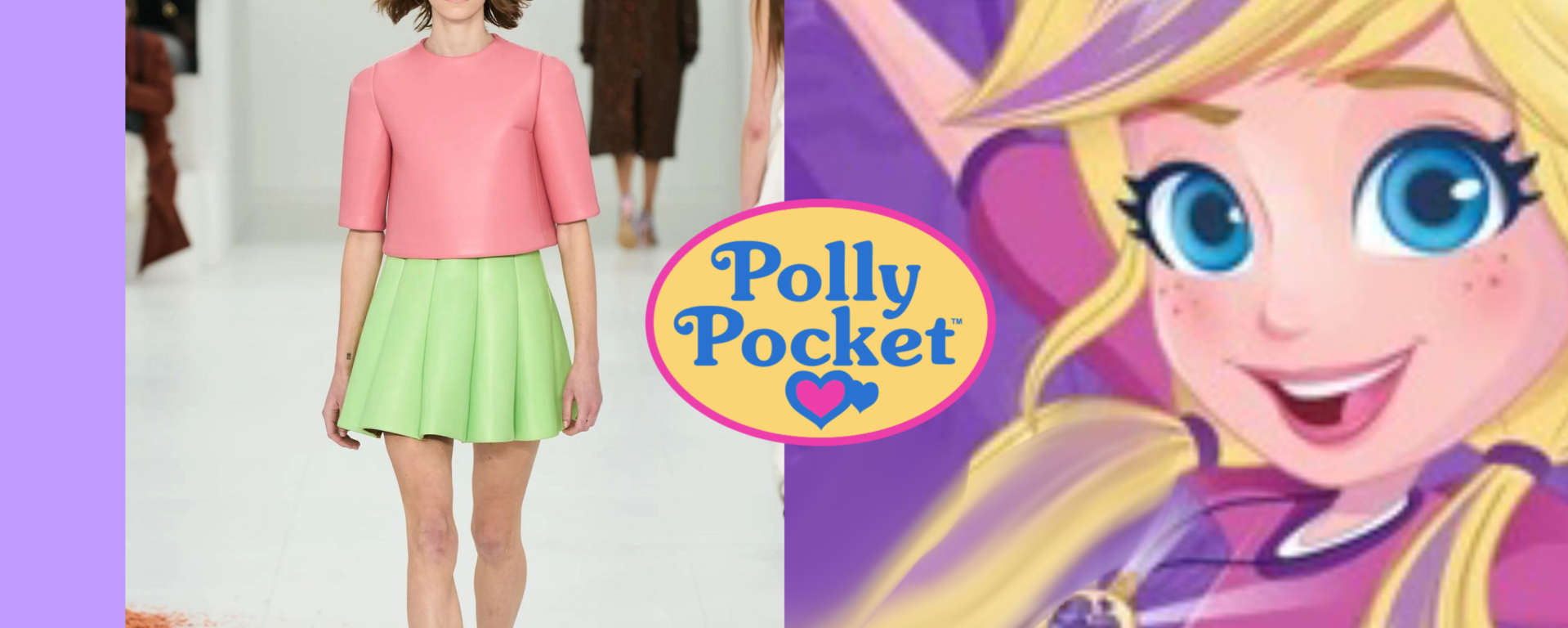
The fashion industry does not seem to have forgotten Polly Pocket, a fashion doll with an intriguing and appealing clothing, despite the fact that cinema has moved on to another Mattel product. Polly Pocket’s wardrobe was more “plastic,” colorful, cartoonish, and sartorial than Barbie’s. Jonathan Anderson, who exhibited certain pieces in Loewe’s FW23 collection that appeared to have been stolen from Miss Pocket’s range of shirts, dresses, shoes, and accessories, must have been one of the kids who grew up with Polly. The structured peplum skirts, shoes, and sunglasses with bulging frames, but notably the ensemble of a pink pepto bismol crop top and a lime green pleated skirt, screamed “Polly Pocketcore” with unmistakable force. On the other hand, Miuccia Prada appears to have dressed Polly’s more sophisticated side with the Miu Miu FW23 show and a collection of short dresses in shining leather.
What would a contemporary Polly Pocket need to buy? Funky bottoms, crop tops, cute tees, short dresses, and colorful clothing with a “shiny” finish blend the flirtatious aesthetic with a lot of 2000s-era vintage clothing. The accoutrements, too? Like the Bubble Jelly Slides by Tory Burch, the Coach Pillow Tabby shoulder bag, the Jacquemus Le Chiquito tiny bag, the Melissa PVC models, the colorful patterns by Poppy Lissiman, the Forbitches bow handbags, and the jewelry by Bea Bongiasca, they are playful, juicy, and comical.
 curlycurlworld: Get Twisted with CurlyCurl: The Latest in Curls, Coils, and Confidence!